
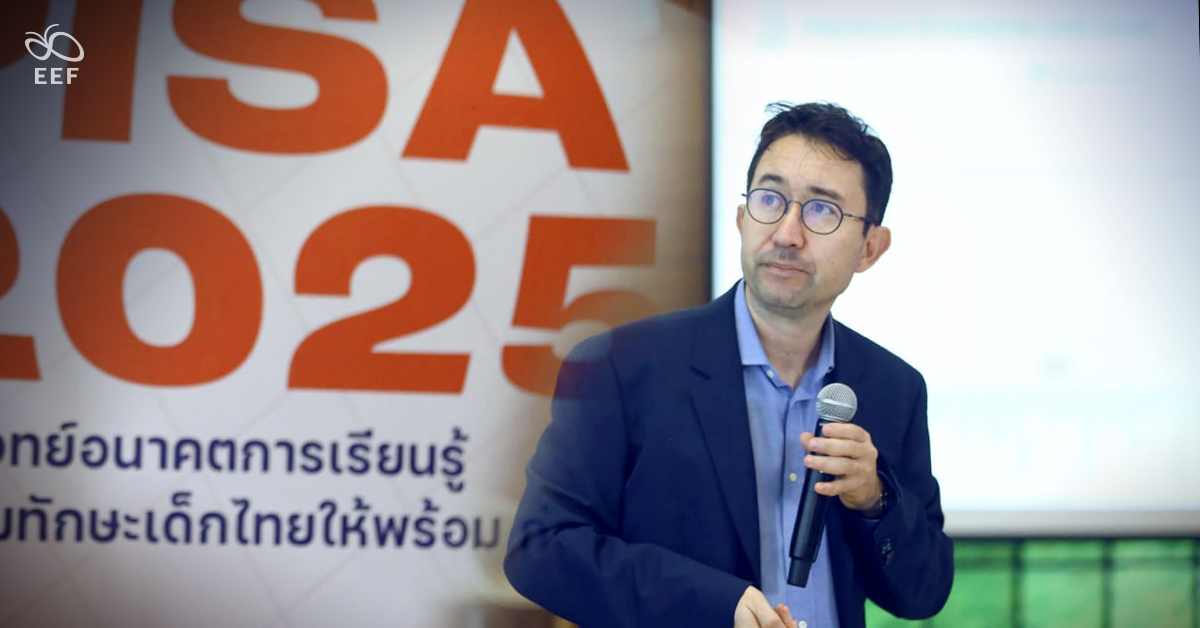
Looking Ahead to PISA 2029 with OECD Senior Analyst Mario Piacentini
“Technology is no silver bullet for educational failure, yet its potential can only be unlocked when applied with clear purpose.” This core message from Mario Piacentini, Senior Analyst at the Organisation for Economic Co-operation and Development (OECD), set the tone at the “Decoding PISA 2025 toward PISA 2029” forum hosted by Equitable Education Fund (EEF) Thailand. The event aimed to chart a concrete path for upgrading Thailand’s education system in an increasingly digital future.
Decoding Thailand’s PISA 2025 Results
In PISA 2025, Thailand achieved scores of 432 points in Science, 407 in Mathematics, and 392 in Reading. While this appears to show a slight recovery from the 2022 pandemic slump, the statistical data reflects no genuine structural change. Across all three subjects, 36.9% of Thai students still fail to reach baseline proficiency—nearly double the OECD average—while only 1.2% perform at a high level in at least one area.
This deficit is most critical in Reading, which has rebounded the least and remains well below its 2012 benchmark of 441 points. Reading comprehension underpins learning across subjects; without it, students struggle to develop higher-level competencies. Ensuring that all learners acquire this foundational skill through equitable, quality education is therefore essential to long-term skill development.
Confronting the Reading Crisis in the AI Era
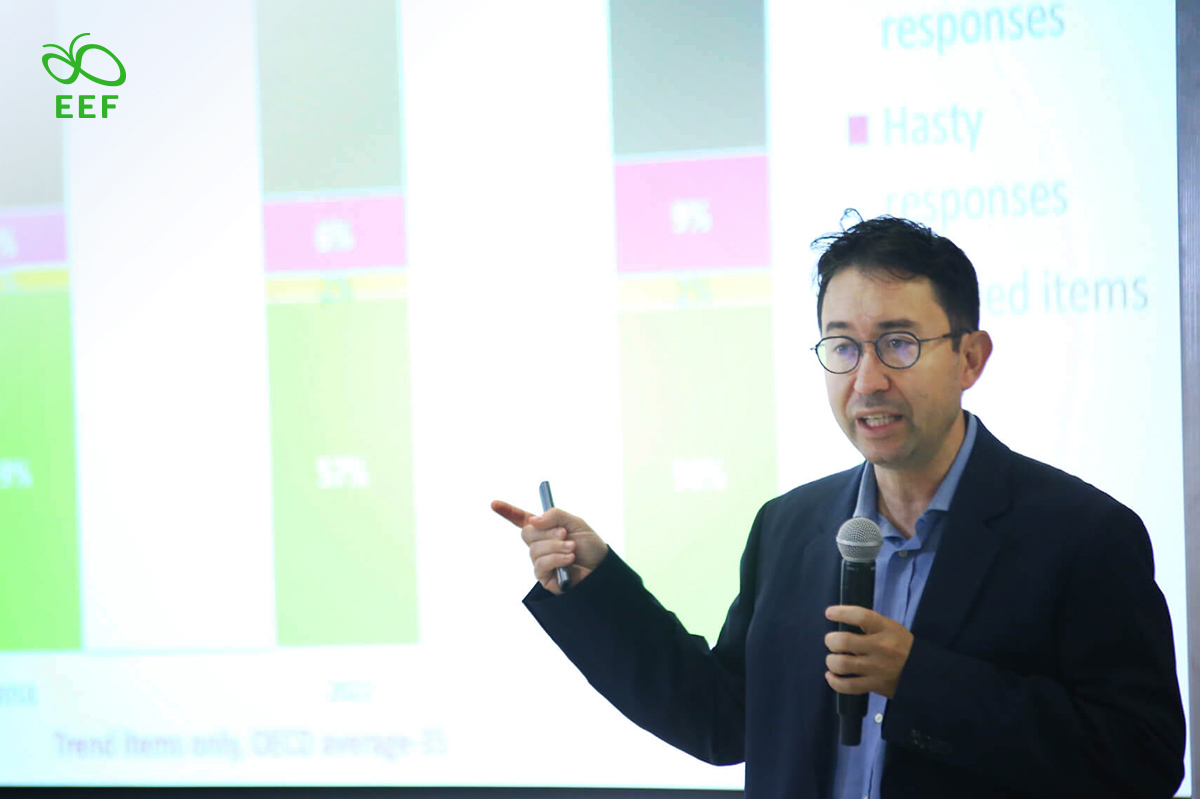
Beyond test scores, student test-taking habits expose deeper structural problems. Hasty responses—where students scroll rapidly through test materials without reading—jumped from 5% in 2018 to 9% in 2025. This behavior stems directly from short-form media consumption on smartphones, which shortens attention spans and degrades analytical processing. The primary problem in modern classrooms is no longer access to information, but the loss of critical comprehension. Artificial Intelligence (AI) accelerates this risk by providing instant answers that encourage students to skip independent analysis entirely.
The core issue lies in how students use AI rather than how often. Using AI in moderation to clarify concepts enhances learning; using it to complete assignments bypasses critical thought and actively lowers academic achievement. Schools must therefore regulate smartphone usage while shifting student evaluation from final answers to clear reasoning and problem-solving steps.
Equipping Thai Learners with Media and AI Literacy for PISA 2029
While nearly 60% of Thai students view school as boring and unhelpful for adult life, their performance in computational problem-solving reveals strong latent capability. When provided adequate resources and structured opportunities, Thai children tackle complex challenges effectively, demonstrating latent talent that only requires systematic support to thrive.
Preparing students for tomorrow requires updating our assessment standards to match these digital realities. While the Learning in the Digital World (LDW) framework in PISA 2025 focused primarily on computational problem-solving, PISA 2029 expands this scope via the Media and AI Literacy (MAIL) framework. MAIL evaluates student critical judgment and ethical responsibility across five core competencies:
- Reflect & Act: Evaluate the accuracy and ethical implications of AI outputs before using them.
- Access & Use: Locate, retrieve, and organize digital information efficiently.
- Analyse & Evaluate: Assess source credibility and identify synthetic media such as deepfakes.
- Participate & Collaborate: Engage online constructively while recognizing algorithmic influences.
- Create: Produce original content while using Generative AI ethically.
Turning Assessment into Classroom Action with Thai PILA
Modern classrooms require tools that meet these demands—a role filled directly by the Platform for Innovative Learning Assessment in Thailand (Thai PILA). Developed jointly by EEF (Thailand) and OECD, Thai PILA delivers formative assessments tailored to local contexts. Through real-time dashboards, teachers track student progress continuously rather than awaiting final exams, enabling immediate instructional adjustments. By restoring reading comprehension and building critical AI literacy, this system ensures Thai students enter PISA 2029 fully prepared.