
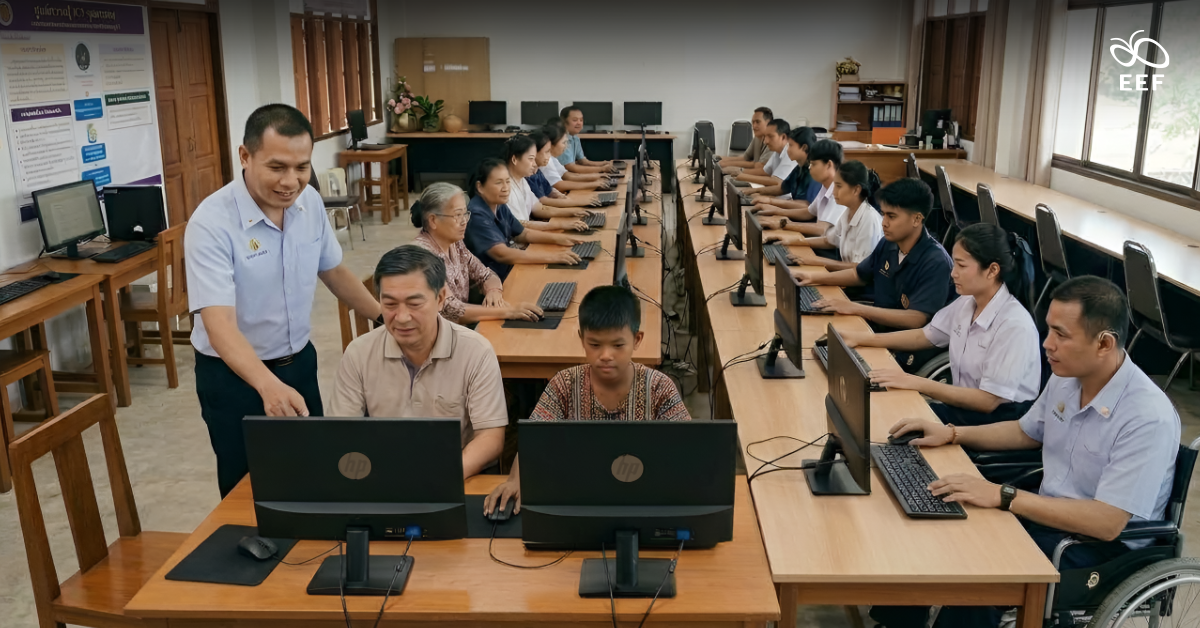
How MOU Commitments, OECD Benchmarks, and “LEARN” Are Re-Engineering
Inclusive Human Capital for Thailand’s High-Income Future
Educational reform achieves lasting impact only when public governance translates national policy into classroom reality, unites multi-agency resources around data-driven pathways, and equips every citizen across all life stages with flexible, future-ready skills aligned with a rapidly changing global economy.
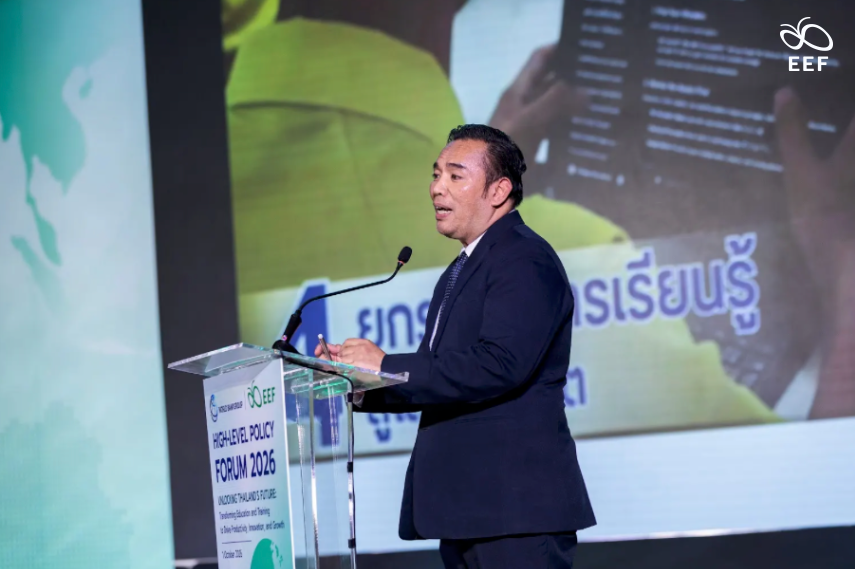
35 years after hosting global finance leaders in 1991, Bangkok once again prepares for the upcoming World Bank Group Annual Meetings—this historic milestone demands bold vision. To meet this moment, Equitable Education Fund (EEF) Thailand, Office of the Vocational Education Commission (OVEC), and World Bank signed a landmark five-year MOU at the High-Level Policy Forum 2026 to modernize vocational education, leverage data-driven research, and build an inclusive lifelong learning ecosystem capable of propelling Thailand toward high-income status by 2037.
Thailand faces a critical development inflection driven by demographic shifts, rapid AI adoption, and evolving market requirements. Speaking on behalf of the Ministry of Education, Dr. Niti Nachit outlined a national direction for education reform that prioritizes more flexible, inclusive, and future-ready learning—positioning Thailand to equip its people for a changing economy and sustain its path towards high-income status.
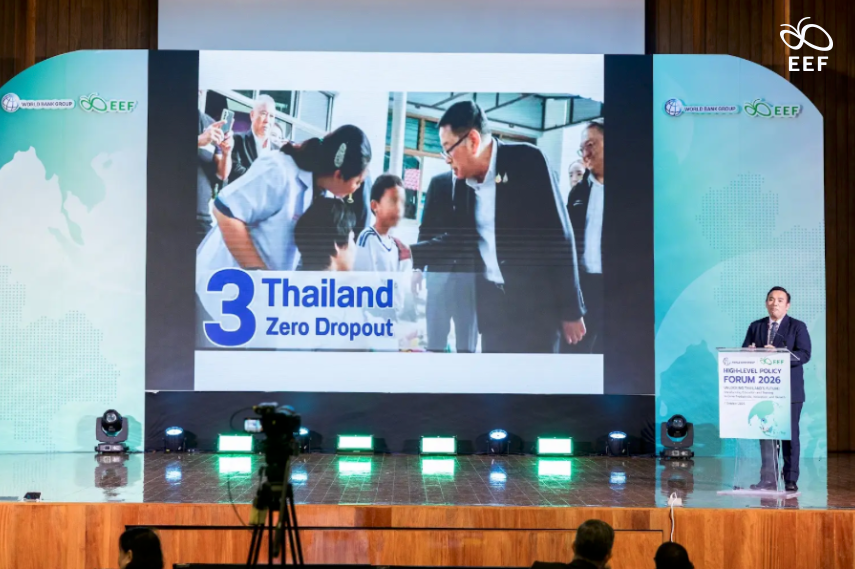
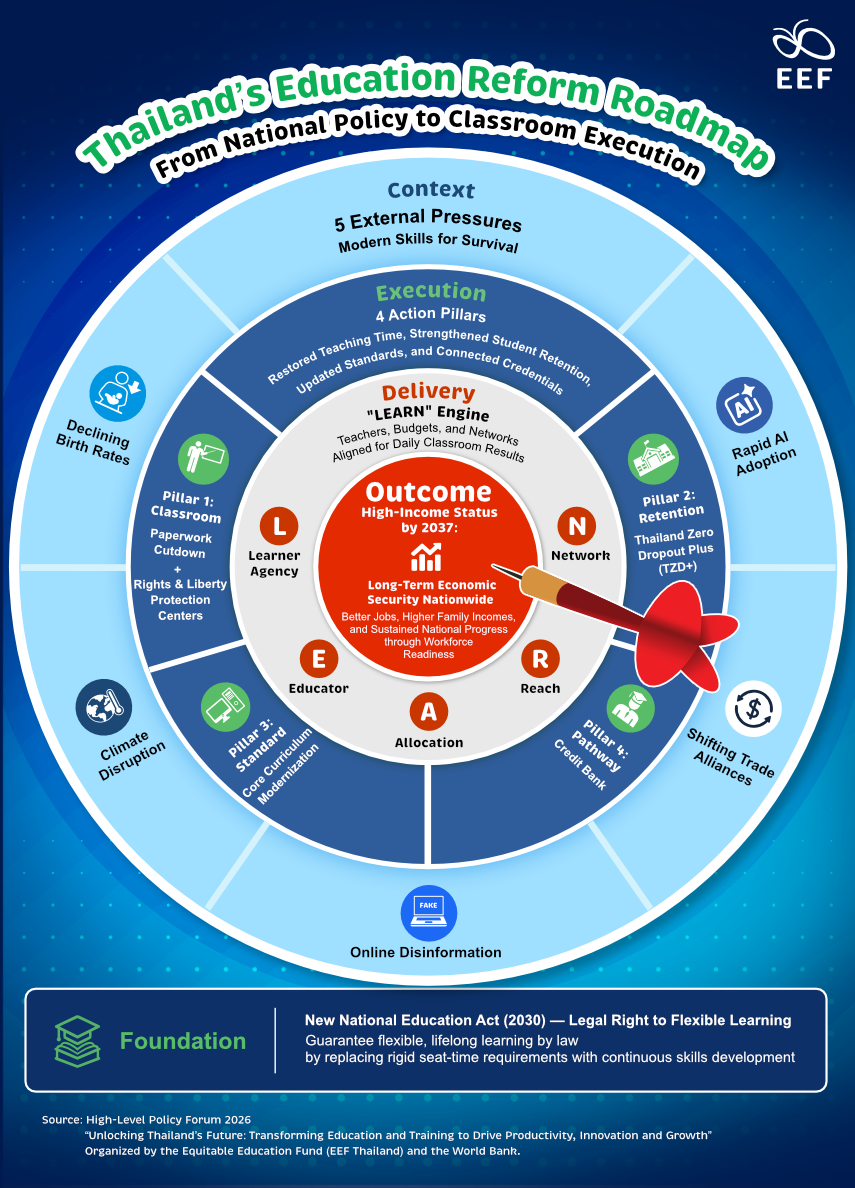
Four Urgent Policy Actions Delivering Direct Classroom Results
Only when policy directly alters daily classroom conditions does educational reform succeed. Paperwork must yield, reclaiming teacher time to unlock instruction. Meanwhile, by establishing the Rights and Liberty Protection Center, public schools embed mental health support that fosters safe spaces where healthy educators cultivate productive classrooms. When rural teachers on PISA assessments converted these extra preparation hours and AI tools into critical-thinking lessons, student scores swiftly surpassed the national average. Keeping students in class then requires economic security, which Thailand Zero Dropout Plus (TZD+) addresses by rewriting funding formulas to deliver direct household aid, pairing social safety nets with scholarships for talented youth before a unified National Curriculum Framework bridges high schools, vocational colleges, and universities into one continuous industrial pipeline, expanding hands-on technical training tied to regional industries.
A New National Education Act as a Permanent Legal Foundation
No single policy win endures without legislative protection—systemic continuity demands law. To secure these gains, the Ministry advances the New National Education Act toward full implementation by 2030. Bypassing administrative reshuffling and bureaucratic re-labeling, this statute establishes a central constitution for learning. Under its authority, every citizen—from early childhood through adulthood—receives a legally binding guarantee of access to flexible educational opportunities, because not until the nation shifts its legal baseline from rigid seat-time requirements to continuous skills development can public education adapt to society’s evolving demands.

Five Global Forces Reshaping Human Capabilities
Modern legal frameworks must respond to real-world disruption; under external pressures, the capabilities people need are redefined. Declining birth rates force public education beyond school-aged children to serve citizens across all life stages. Simultaneously, the swift rise of AI reshapes workplace demands, requiring schools to integrate technological instruction so graduates master modern tools rather than suffer displacement. This economic urgency compounds as climate change disrupts local livelihoods, turning environmental sustainability and disaster resilience into essential survival skills, all while shifting trade alliances demand international language fluency, practical technical capabilities, economic agility, and critical thinking to combat rampant online disinformation.
Four Practical Dimensions Connecting Education with Real-World Needs
Outdated assumptions cannot guide policy; verified market facts must. To navigate global shifts, the Ministry restructures learning across four practical dimensions. Aligning labor market data with international benchmarks—including Thailand’s ongoing OECD accession standards—ensures school subjects mirror actual job requirements. Tracking comprehensive student data then enables schools to design personalized study routes linking personal strengths directly to market vacancies, where transition mechanisms like the national Credit Bank allow citizens to convert work experience, vocational certificates, and online courses into official diplomas. Not without modernizing core subjects toward data literacy, practical science, global communication, emotional resilience, and digital skills can education bridge the gap between classroom theory and real-world execution.
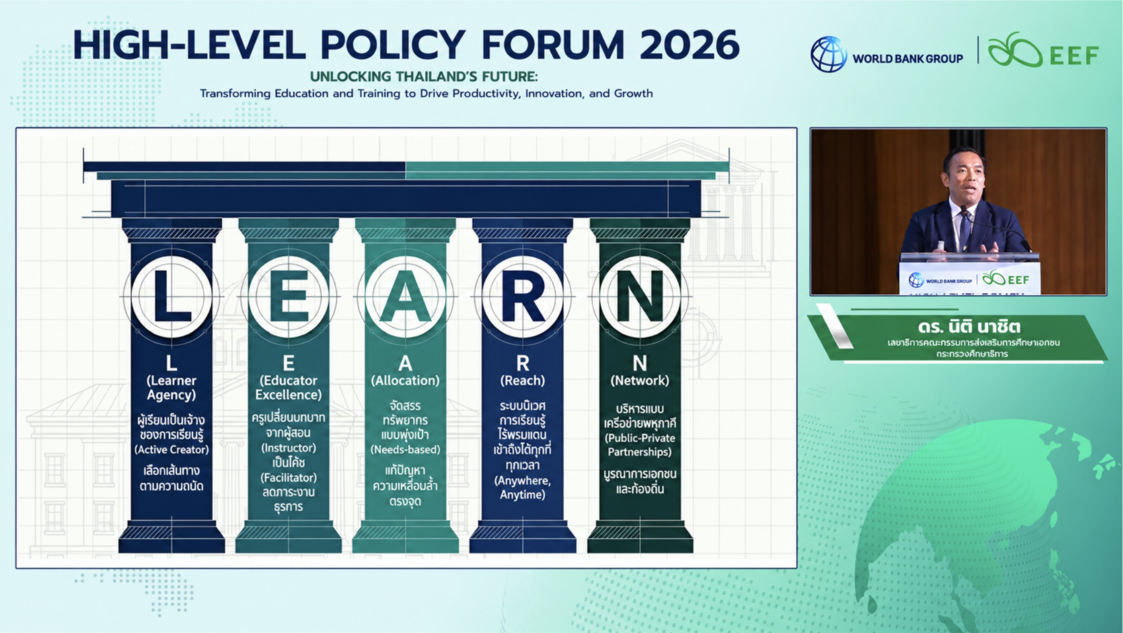
“LEARN” Framework Empowers Citizens to Thrive in a Changing World
Economic alignment produces a new generation of Thai citizens. Systemic reform yields healthy, adaptable, sustainability-minded lifelong learners who create value and act ethically. To realize this vision, the Ministry applies the practical “LEARN” framework.
- Learner Agency (L) empowers students to pursue personalised learning pathways aligned with their strengths.
- Educator (E) recasts teachers as facilitators who cultivate critical thinking and connect learning to real-world practice.
- Allocation (A) directs funding to the communities facing the greatest educational inequality.
- Reach (R) builds a borderless learning ecosystem accessible anytime, anywhere.
- Network (N) unites public agencies, businesses, and communities through “All for Education” to mobilise resources nationwide.
Shared Commitments for Sustainable Systemic Transformation
Fragmented agencies waste public funds; cohesion drives progress. Thailand fixes structural disconnection by unifying labor data, flexible credit transfers, and targeted local funding into one national strategy. Only when national policy restores teaching time, safeguards student health, delivers direct financial assistance, and validates non-formal learning does education cease to be a rigid obligation. Supported by joined-up commitments across the Ministry of Education, EEF (Thailand), the World Bank, and local communities, public education becomes a reliable engine for better jobs, higher family incomes, and sustained national progress.
Source:
High-Level Policy Forum 2026
“Unlocking Thailand’s Future: Transforming Education and Training to Drive Productivity, Innovation and Growth”
Organized by the Equitable Education Fund (EEF Thailand) and the World Bank.