
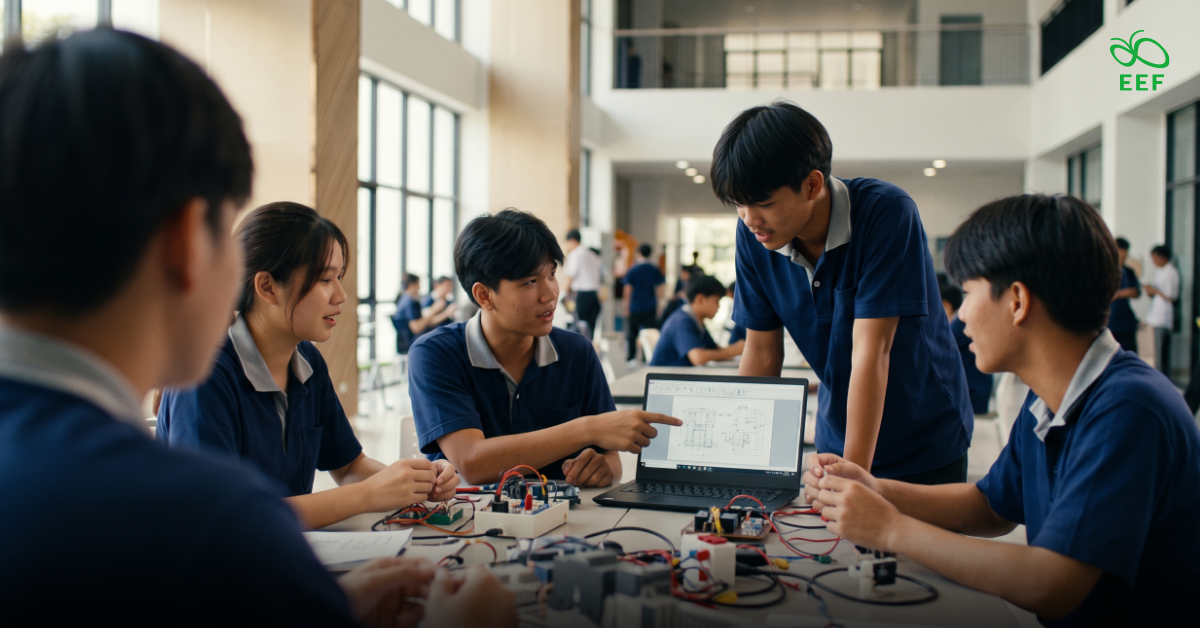
Why Economic Progression Depends on Early Literacy, Industry Co-delivery, and Portable Credentials
Economic progression is a foundation for high-income status and shared prosperity, realized only when basic education systems guarantee early foundational mastery, industry-embedded training adapts to real labor markets, and national policy frameworks fund lifelong credit integration.
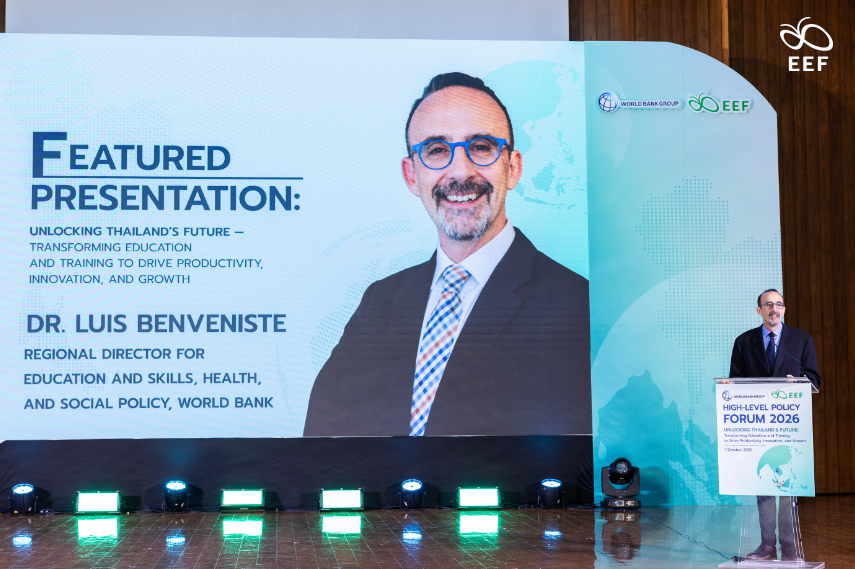
35 years after hosting global finance leaders in 1991, Bangkok once again prepares for the upcoming World Bank Group Annual Meetings—this historic milestone demands bold vision. To meet this moment, Equitable Education Fund (EEF) Thailand, Office of the Vocational Education Commission (OVEC), and World Bank signed a landmark five-year MOU at the High-Level Policy Forum 2026 to modernize vocational education, leverage data-driven research, and build an inclusive lifelong learning ecosystem capable of propelling Thailand toward high-income status by 2037.
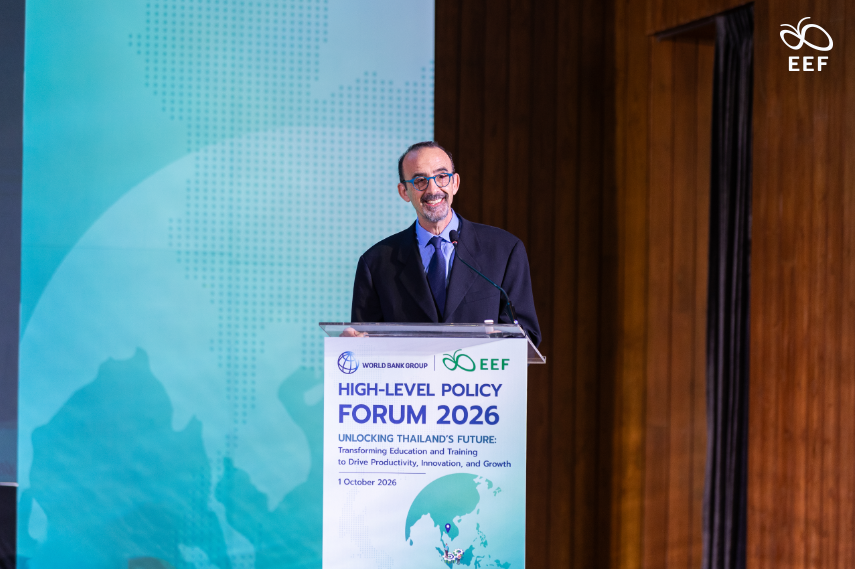
Thailand faces a critical development inflection driven by demographic shifts, rapid AI adoption, and evolving market requirements. In response, EEF (Thailand) provided a platform for World Bank Regional Director for Education and Skills, Health, and Social Policy Dr. Luis Benveniste to call for closing skills gaps that constrain innovation and employment security, demonstrating that inclusive, lifelong skills development is core economic infrastructure for productivity, mobility, and sustained national competitiveness.
From Historical Growth to Human Potential: Closing the Foundational Deficit
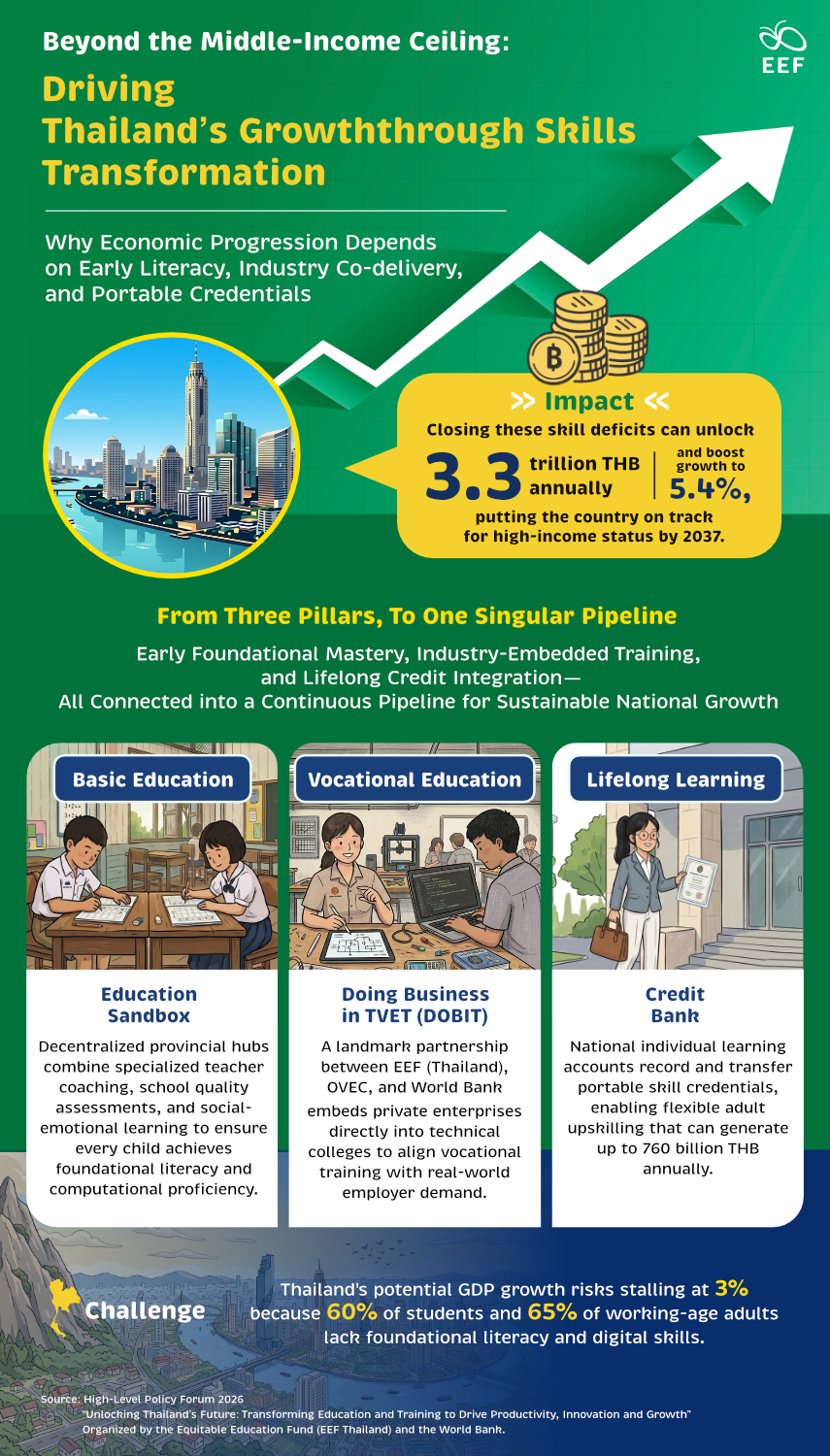
A landmark World Bank and EEF analysis reveals a stark economic reality: without immediate structural reform, Thailand’s annual growth risks stagnating at roughly 3%. Behind this plateau lies a pervasive learning crisis: over 60% of Grade 2 students and 15-year-olds fall below basic learning thresholds, while 65% of working-age adults lack foundational literacy and digital skills.
Only when public institutions resolve these foundational deficits can the nation escape upper-middle-income stagnation. The next task is to convert stronger foundational learning into market-relevant capability: co-designed pathways with industry can link early education, technical training, and lifelong upskilling into a single system aligned with demand. This integrated approach could lift potential annual growth to 5.4% and support Thailand’s transition to high-income status by 2037.
Productivity Engine: Converting Basic Literacy into Economic Capital
OECD data further confirm that national productivity hinges on human skills. Up to one-third of cross-country productivity differences can be attributed to variations in workforce capabilities demonstrating that no advanced industrial economy can thrive while foundational human competencies remain neglected.
Only when local institutions address these foundational gaps can private enterprises overcome the severe recruitment difficulties currently afflicting 62% of employers. Targeted learning interventions must equip workers across the economy to integrate AI flexibly, rather than confining them to narrow technical specializations. This coordinated enhancement of national capability could ultimately unlock an estimated 3.3 trillion Thai Baht in annual economic gains.

Classroom Innovation in Practice: Scaling Competency through Local Autonomy
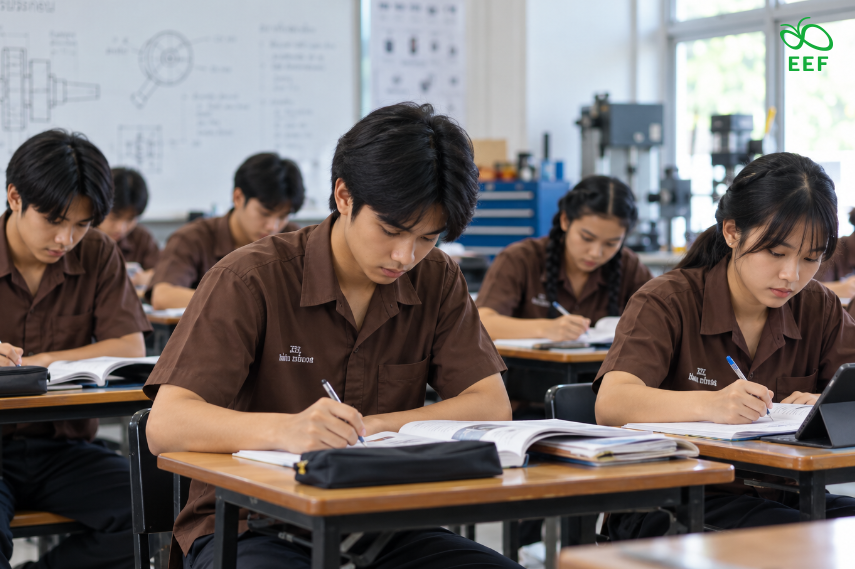
Bridging national policy and local execution requires an adaptable framework, like the Education Sandbox. Established as decentralized provincial hubs, these regional networks test competency-based learning directly within local classrooms, pairing curricular autonomy with specialized teacher coaching, school quality assessments, and social-emotional learning. Through these field-tested models, regional ecosystems systematically upgrade basic instruction, ensuring that no student leaves school without mastering essential proficiencies.
Industry Inside the Campus: Aligning Vocational Training with Market Demand
Only when technical colleges directly reflect industrial reality can vocational education fulfill its economic purpose, notably through models like Doing Business in TVET (DOBIT). By actively embedding private enterprises in technical instruction, this public-private co-delivery model removes the traditional divide between academic schooling and industrial production. Through these immersive environments, trainees acquire advanced technological capabilities directly inside workplace-integrated colleges that align graduate skills with actual labor market demands.

Infinite Pathways: Securing National Competitiveness through Lifelong Learning
With adult training participation lingering below 10%, Thailand’s national competitiveness faces a critical bottleneck in workforce adaptability. To eliminate this bottleneck, the country is building an integrated skills infrastructure that links Individual Learning Accounts to national qualification frameworks through Credit Bank. Not until this credentialing network validates competencies across formal schooling, workplace training, and micro-credential programs can workers seamlessly carry verified skills across career transitions, providing employers with reliable proof of expertise and unlocking up to 760 billion Thai Baht in annual economic value.
Systemic Coherence: A Portable Capability Framework for Thailand’s Future
Through these three core initiatives, workers and students can navigate a seamless development pipeline—Education Sandbox securing early foundation; DOBIT providing industry-embedded vocational instruction; and Individual Learning Accounts recording competencies across every career phase. Linking early skill mastery, targeted instruction, industry alignment, and recognized lifelong progression, the system turns initial outreach into sustained economic mobility.
Expanding human capability beyond rigid schooling models provides diverse populations with accessible, high-value routes into the modern economy. Not only does lifelong development boost personal resilience, but it also elevates national competitiveness. Notably, EEF’s (Thailand) Credit Bank records learning from school, training, and work, allowing people to collect and carry recognized credits as they move between study and employment. It gives Thailand a practical lifelong-learning system: workers can update their skills when jobs change, while employers gain a workforce whose capabilities are visible, current, and easier to develop.
Source:
High-Level Policy Forum 2026
“Unlocking Thailand’s Future: Transforming Education and Training to Drive Productivity, Innovation and Growth”
Organized by the Equitable Education Fund (EEF Thailand) and the World Bank.