
Why AI-Resilient Early Careers Require Industry-Aligned Skills and Unbroken Progression Pathways
An AI-resilient path from school to work is possible for all young people when education is affordable, vocational courses are designed with industry, and scholarships support continued study into higher education and employment.
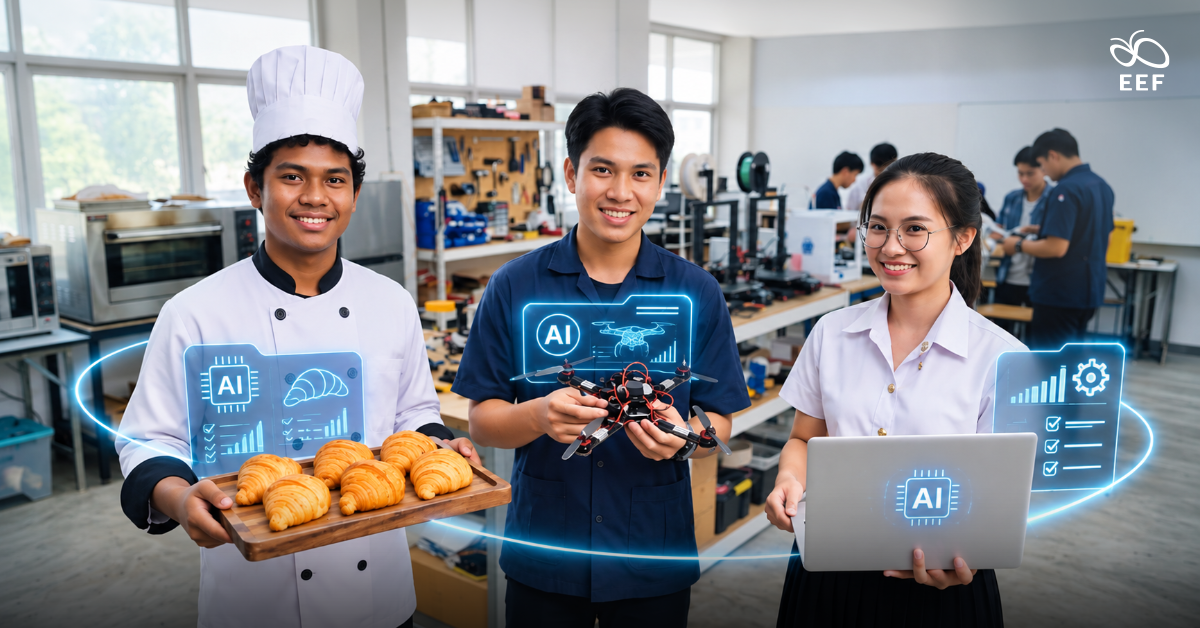
Artificial Intelligence (AI) is rapidly reshaping the transition from school to work, especially for young people entering their first jobs. Vocational pathways can offer an advantage by blending educational opportunity with hands-on skills, industry learning, and clearer routes into further study or employment—provided that access to the learning, tools, and real-world experience needed to work alongside AI is not limited by background or income. The Equitable Education Fund (EEF) Thailand therefore positions vocational education as an equitable route through which young people gain practical capability, workplace experience, and recognized progression—supported through the High Vocational Innovation Scholarship and the Phra Kanittha Summacheep Scholarship.
From Routine Tasks, to High-Order Capability: Redesigning Entry-Level Roles with Learning through Application
According to the World Economic Forum‘s report “Artificial Intelligence and the Future of Entry-Level Work,” AI is rapidly transforming early-career jobs. Globally, 37% of young workers—and 35% in Southeast Asia—hold positions with medium to high exposure to AI. In these highly exposed roles, required skills are changing nearly three times faster than those in non-exposed roles. Consequently, 28% of entry-level workers believe over half of their skills will be outdated within three years, while unequal access to tools and training threatens to widen career inequality.
This shift redefines what companies need from new hires. With AI automating routine data processing, entry-level employees must quickly learn to evaluate AI outputs, solve practical problems, and handle complex technical and human systems. Rather than trying to preserve traditional entry-level jobs, the focus must shift to rebuilding early-career pathways to help young workers develop critical judgment and adaptability alongside technology.
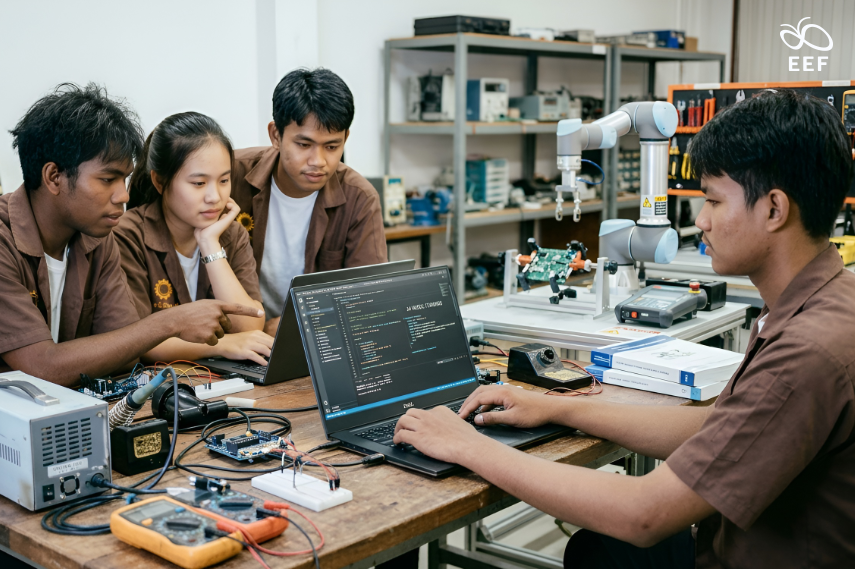
Vocational education offers a direct solution to this challenge by combining classroom learning with hands-on practice. Through workshops, labs, industry projects, and real workplace environments, students gain practical experience that complements theoretical knowledge. Applied learning teaches young professionals how operations function, how quality standards are maintained, and how to use technology responsibly. These core capabilities cannot be gained from software alone; they require deliberate practice, direct feedback, and active exposure to actual working environments.
From Educational Gaps, to Workforce Alignment: Linking Equity with Skills through Work-Based Learning
With its vocational mission, EEF (Thailand) addresses two interconnected challenges: unequal access to post-compulsory education and acute skilled-labor shortages. Its programs assist economically disadvantaged youth by funding education that builds practical competence—not only tied to economic demand but also leading towards sustainable future opportunities. To achieve this, the fund collaborates with vocational institutions, community colleges, universities, public agencies, and private enterprises to build training pathways targeted at emerging industries and STEM fields with skilled-labor shortages.
From Cost Obstacles, to Market Readiness: Co-Designing Industry Curricula
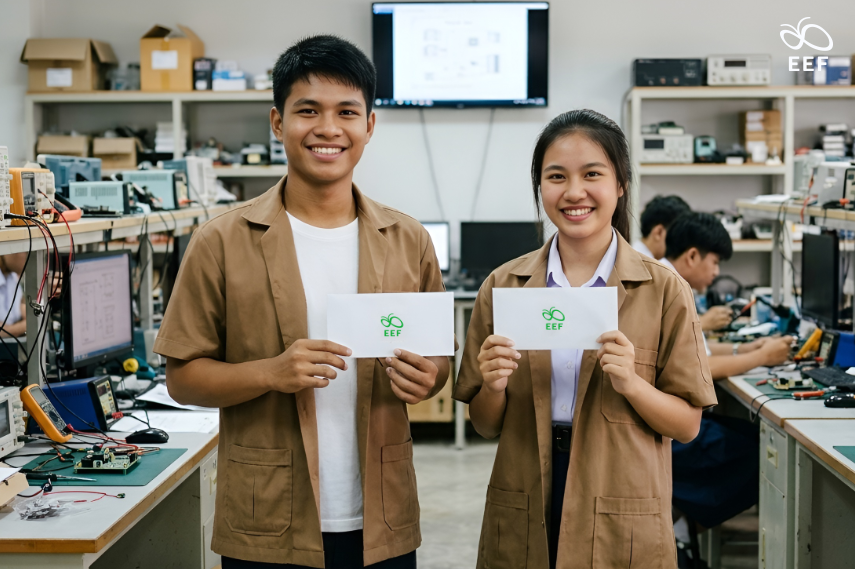
High Vocational Innovation Scholarship supports higher vocational studies for economically disadvantaged students, covering two-year and five-year vocational certificate sequences as well as targeted one-year assistant nursing and assistant dental certificates. Participating educational institutions must design their curricula jointly with private enterprises using recognized occupational competency standards. This direct collaboration ensures that student training matches actual market demand and operational practices.
From Terminal Qualifications, to Advanced Pathways: Unlocking Professional Mobility
Phra Kanittha Summacheep Scholarship provides advanced educational funding for high-potential vocational graduates from low-income backgrounds. It enables students holding vocational or higher vocational certificates to pursue bachelor’s degree through postgraduate studies. By focusing on national priority sectors, including S-Curve and New S-Curve industries, as well as STEM and digital technology, the scholarship ensures that choosing a vocational track expands—rather than limits—a student’s long-term academic and professional opportunities.
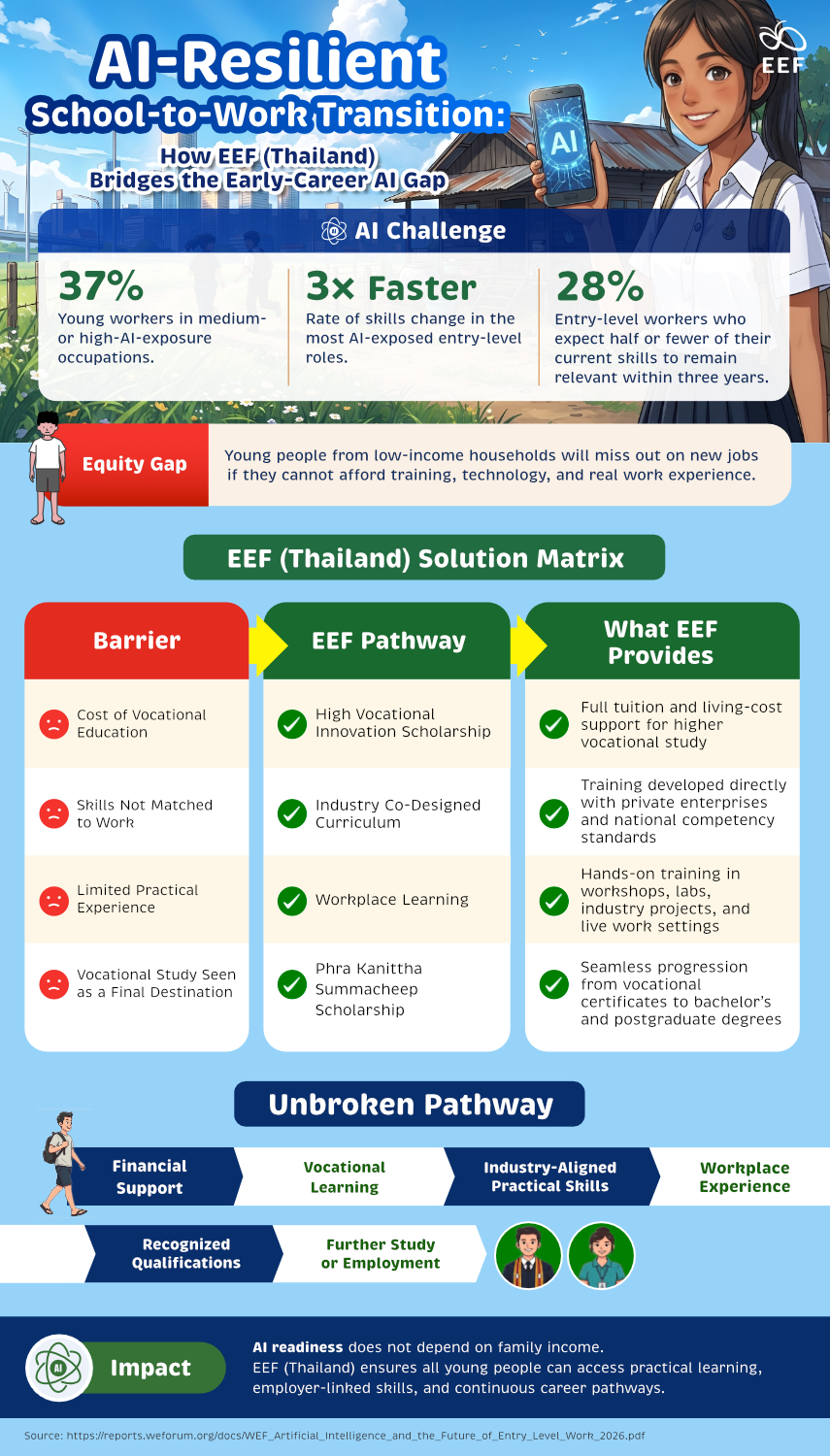
Together, the two scholarships create a continuous pathway from vocational learning to long-term career and academic advancement: the High Vocational Innovation Scholarship helps financially disadvantaged learners gain industry-aligned practical skills and workplace readiness, while the Phra Kanittha Summacheep Scholarship enables vocational graduates to progress into bachelor’s and postgraduate study. Rather than limiting future options, vocational education becomes a foundation for recognized qualifications, professional mobility, and sustained opportunity.
Yet qualifications and workplace experience alone are not sufficient. Vocational students also need the curiosity to keep learning, the adaptability to respond to changing workplace demands, and the judgment to use AI-generated information responsibly. These socio-emotional capabilities help learners apply technical knowledge effectively and work alongside AI. In addition to its scholarship programs, EEF (Thailand), through its collaboration with the World Bank, is advancing the development of these transferable skills as a core foundation for vocational students’ sustainable employment in an AI-shaped economy.
From Systemic Privilege, to Shared Opportunity: Converting Readiness into Scale
Preparing young people for an AI-shaped economy requires removing the cost barriers that prevent low-income students from acquiring practical, industry-aligned skills and accessing the early-career pathways through which they can build confidence and progress alongside technology. By eliminating tuition obstacles, embedding enterprise partnerships, and creating clear routes from vocational study into higher education or employment, EEF (Thailand) scholarship programs transform an AI-resilient school-to-work transition from an exclusive privilege into an accessible reality.
Source: https://reports.weforum.org/docs/WEF_Artificial_Intelligence_and_the_Future_of_Entry_Level_Work_2026.pdf