

Why NEET Re-Engagement Requires Data-Driven Tracking and Portable Credentials
NEET re-engagement is a foundation for secure employment and lifelong stability, realized only when integrated databases locate out-of-school youth early, flexible learning pathways adapt to real living conditions, and public institutions and private employers permanently recognize non-formal learning credits.
Young people not in employment, education, or training (NEET) face disengagement driven by overlapping factors like poverty, disability, caregiving, and immediate income needs. Addressing these complex constraints requires flexible educational systems that adapt to real lives rather than forcing every learner back into traditional classrooms. In response, the Equitable Education Fund (EEF) Thailand advances flexible learning as an equitable re-entry route—enabling young people to combine learning with work and daily responsibilities while gaining recognized, transferable credentials that support sustained progression into further education and employment.

Bridging Systemic Gaps: When Flexibility Becomes the Core Mechanism for Re-Engagement with Education and Employment
A joint report “Flexible Learning Strategies That Work: Promising Approaches and Recommendations for Youth Not in Employment, Education, or Training (NEET) in South-East Asia” by UNESCO Bangkok and EEF (Thailand) highlights a regional crisis of 17 million out-of-school youth across Southeast Asia. Within this population, one in five young people aged 15–24 is NEET, with young women 1.5 times more likely to be disengaged due to unequal domestic care burdens and social constraints.
Solving this widespread exclusion requires co-designing flexible learning pathways directly alongside disengaged youth to align with their actual needs and living conditions. Only when public institutions and private employers recognize non-formal learning credentials do these flexible alternatives gain lasting value.
Unlocking Visibility: When Individual Data Drives Early Intervention
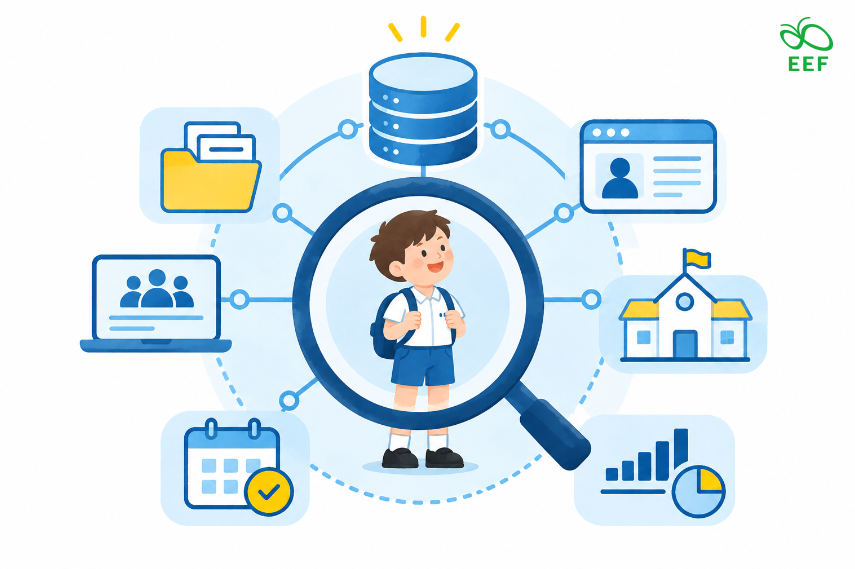
EEF (Thailand) operates on the premise that public systems cannot support learners who remain invisible in official records. Integrated database systems collect individual-level data to detect early signs of detachment before a student drops out permanently. Detecting these at-risk learners allows cross-sector networks in health, welfare, and employment to intervene alongside educators. This coordinated support transforms education from a rigid physical requirement into an active safety net: one that addresses individual well-being and creates safe, supportive spaces in which young people can rebuild trust, participate at their own pace, and re-enter learning.
Thailand Zero Dropout Plus (TZD+): When Integrated Systems ocate Out-of-School Youth
The Thailand Zero Dropout Plus initiative translates this multi-agency approach into a national framework for tracking and reconnecting out-of-school children. A centralized database combined with the Thai Zero Dropout Application aggregates government data to isolate specific causes behind each student’s absence. These diagnostic insights enable local teams to execute a structured four-step operational response: Find, Assist, Re-engage, and Connect. This sequence guides each identified youth from initial tracking directly back into accredited, tailored learning pathways.
Learn to Earn: When Education Adapts to Economic Necessity
Within this re-engagement framework, the Learn to Earn initiative targets youth aged 15–18 who must earn an income while building relevant skills for the workforce. Operating under a flexible “1-School-3-Model” model, this pathway removes the dilemma between immediate employment and continued study. Participating youth acquire practical competencies directly on the job through local employer partnerships. These workplace experiences simultaneously build verifiable academic and vocational credits without interrupting daily wage earnings.
Learning Passport: When Life-Long Credit Banks Eliminate Academic Loss
Thailand’s approved flexible learning policy supports long-term continuity by introducing the Learning Passport, an individual learning account tied to a citizen’s national ID card. This national credit-bank system records, stores, and transfers learning credits earned across formal schools, non-formal centers, digital platforms, and workplaces. Accumulating verified competency profiles prevents returning students from losing past academic progress during unforeseen circumstances. These portable credentials offer higher education institutions clear records for credit transfer while providing employers verified proof of job readiness.
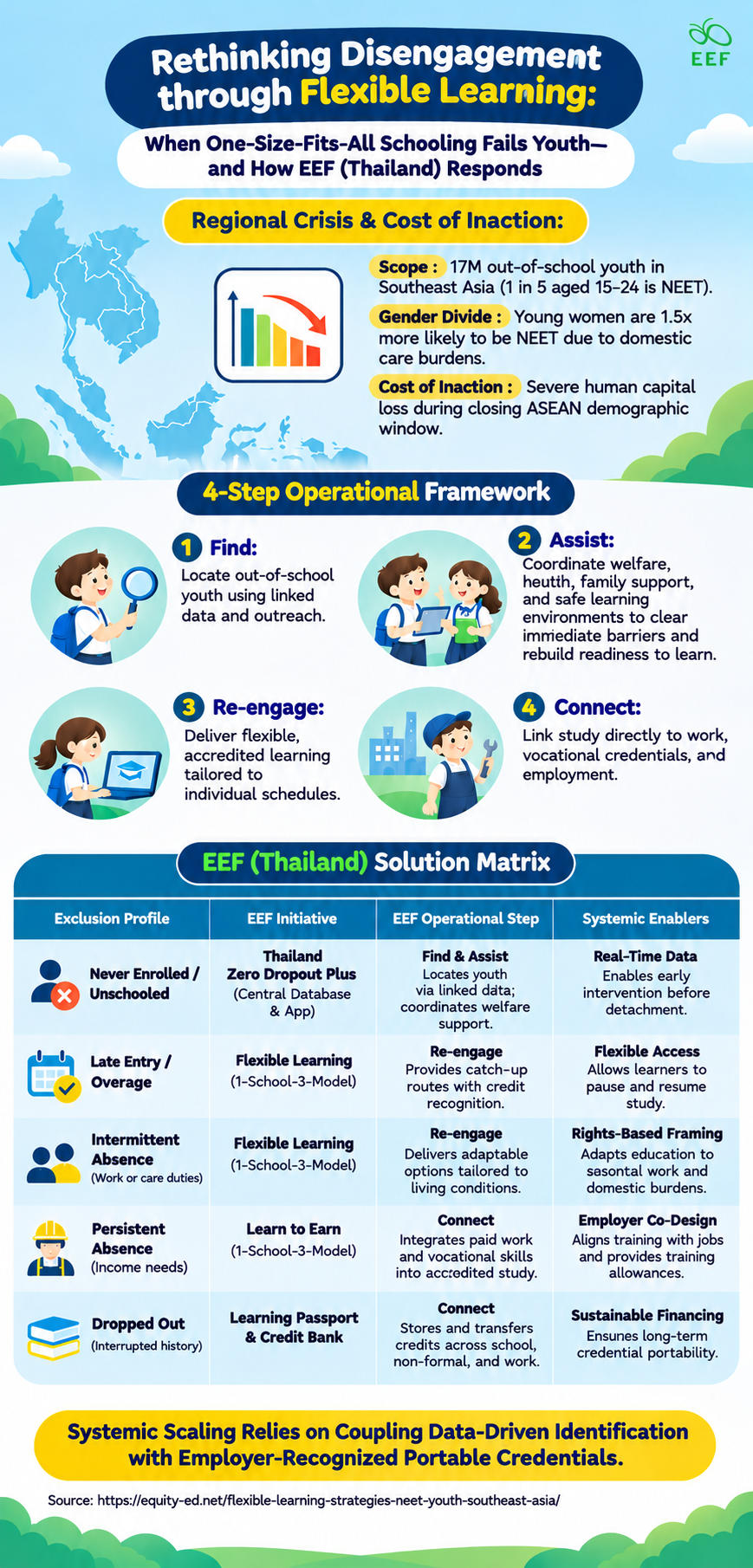
Through these three initiatives, NEET children and young people can move through a clear process: Thailand Zero Dropout Plus uses integrated data and local outreach to identify them and assess barriers to return; Learn to Earn provides a study-and-work option for those who need an income; and the Learning Passport and Credit Bank record credits earned through school, training and work for future use. The system therefore links early identification, tailored support, flexible participation and recognized progression.
Portable Qualifications, Portable Futures: When Systems Travel With the Learner
Expanding educational access beyond traditional classroom walls provides vulnerable youth with practical pathways back into the workforce and society. EEF (Thailand) initiatives demonstrate that when learning pathways adapt to the individual, education becomes a lifelong tool for secure employment and stability.
Source: https://equity-ed.net/flexible-learning-strategies-neet-youth-southeast-asia/