

Why Funding Real Costs Is the Key to Transforming School Finance and Realizing “Education for All”
Equitable education is realized only when school budgets move beyond equal per-head division to fund the true cost of operating campuses and supporting vulnerable learners.
For over two decades, Thailand has funded basic education through a straightforward per-head formula. Yet, uniform funding only works when students start from uniform conditions. When applied to a landscape where rural schools lack basic infrastructure and vulnerable students face overwhelming socio-economic pressures, equal distribution deepens structural inequality rather than resolving it.
To address this gap, Equitable Education Research Institute (EEFI) under Equitable Education Fund (EEF) Thailand is working alongside the Ministry of Education to shift school funding from flat equality to equity-based budgeting. Only by adjusting national formulas to reflect the real operational costs of running campuses can state allocations guarantee that no student is left without a complete foundation for learning. Led by EEFI Director Asst. Prof. Dr. Sahawarat Polahan, this effort targets system-wide reform.

Reality of How Flat Funding Falls Short
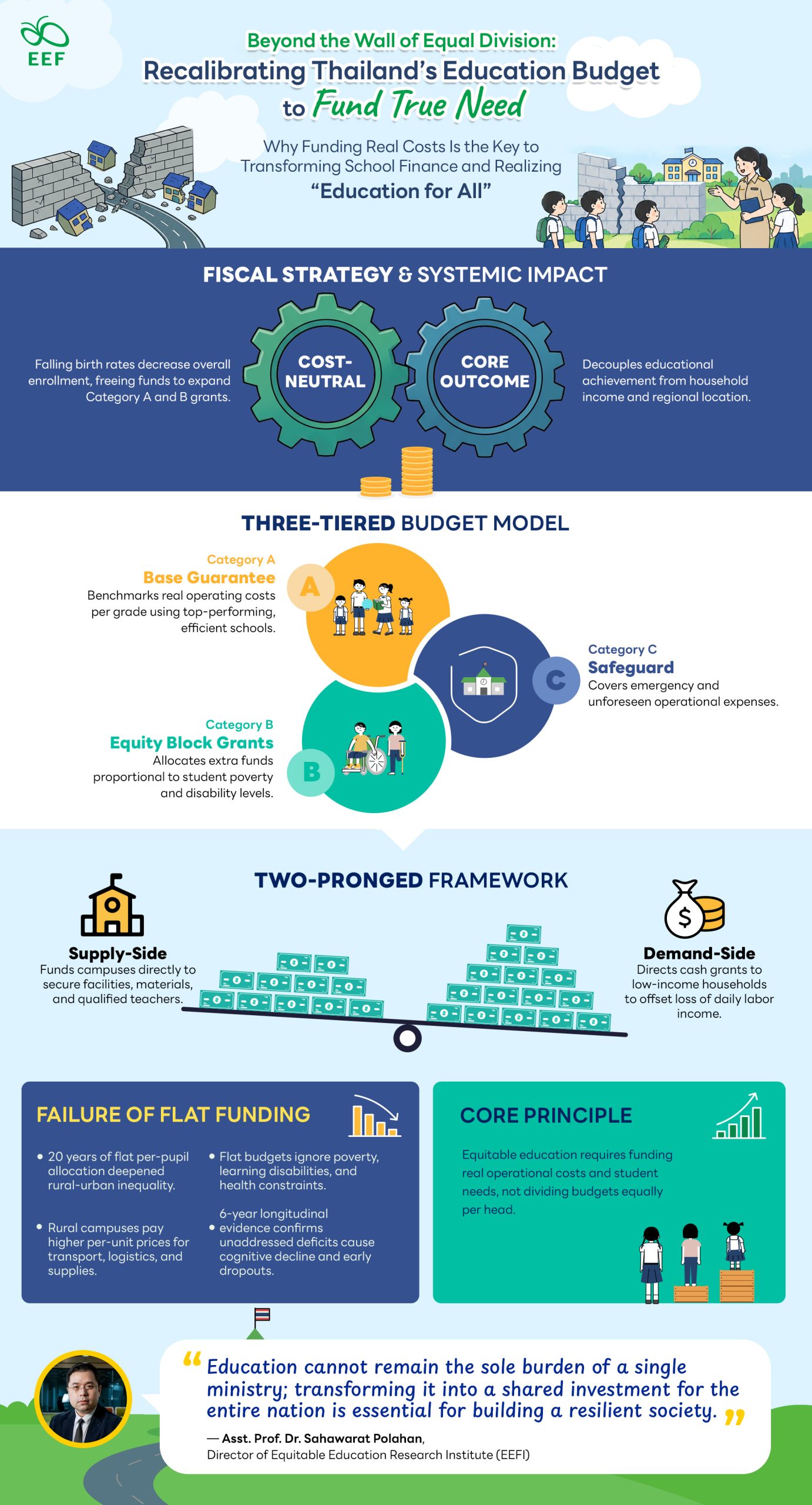
Flat-rate funding assumes the same overhead costs for every school and the same baseline readiness for every student. In practice, small rural schools pay higher per-unit prices for transport, logistics, and materials, while struggling to retain qualified teaching staff. Not only do these persistent deficits severely undermine student achievement, but they also leave vulnerable children confronting unaddressed structural barriers—such as learning disabilities, developmental delays, chronic health constraints, and gender-based discrimination—that standard per-student allocations fail to diagnose.
Longitudinal tracking studies conducted by EEF (Thailand) alongside the University of the Thai Chamber of Commerce (UTCC) reveal a startling reality: students followed over a six-year period showed declining cognitive performance over time. “This decline in learning outcomes is an urgent alarm, showing that without adequate resources, an under-resourced school environment actively erodes a student’s cognitive capital year after year,” warned Dr. Sahawarat. When classrooms lack essential operational capacity, student engagement drops, converting persistent instructional deficits straight into early school departure.

Two-Pronged Framework for Resource Allocation
To structure national school funding effectively, EEFI proposes dividing educational expenditure into two distinct economic mechanisms: supply-side funding targets campuses while demand-side support targets households. While supply-side allocations guarantee functional facilities, learning materials, and administrative stability at the institutional level, demand-side grants provide direct financial relief to impoverished families at the student level. For low-income households, sending a child to school can mean sacrificing daily income needed for basic household survival, whether from seasonal labor or agricultural work.
As EEFI Director explains, “When families face severe economic hardship, they weigh the immediate earnings of daily labor against attending school, which is why government support must directly offset this opportunity cost to keep children in the classroom.” Seldom does a single financial intervention solve both institutional and household pressures, yet this dual approach removes the financial barriers that keep children out of school while ensuring that schools have the capacity to deliver meaningful learning once they arrive.
Three-Tiered School Budgeting Model
The Ministry of Education’s immediate reform priority is school-level funding, structured through a three-tiered model that distinguishes between universal provision, equity adjustment, and exceptional support: Category A establishes the minimum operating budget every school requires to function effectively; Category B provides supplementary funding where concentrations of vulnerability create a larger gap between available resources and actual need; and Category C serves as a residual safeguard, covering exceptional or unforeseen costs that remain beyond the reach of the first two categories.
Category A applies the Best School Approach to calculate actual operational expenses. By evaluating high-performing, efficiently managed campuses, the model establishes an evidence-based cost benchmark for every grade level. The difference between this benchmark and an underfunded school’s current allocation defines the funding gap that public investment must bridge. Meanwhile, Category B addresses the unequal conditions that make this gap more severe for some schools than for others. Its supplementary Equity Block grants are calculated by multiplying a school’s funding gap by the proportion of enrolled students living in poverty, living with disabilities, or requiring specialised learning support.
“Equity-based budgeting means directing higher supplementary resources to schools with larger populations of vulnerable learners so they can achieve truly equal learning opportunities,” stresses Dr. Sahawarat. Standard campuses under 50 students will not receive Category B grants, prompting smaller schools to consolidate faculty and administration through nearby networks. Remote campuses remain fully exempt, retaining complete Category B eligibility regardless of enrollment, proving that access must take precedence over pure operational efficiency.

Achieving Reform through Budgetary Efficiency
Transitioning to an equity-based system does not require expanding the total national education budget. As student numbers decline across Office of the Basic Education Commission (OBEC) schools, automatic fiscal savings emerge. These operational surpluses directly fund the expansion of Category A baseline guarantees and Category B equity grants without increasing overall pressure on state coffers.
As EEFI Director highlights, “Transitioning to a new budget model requires a managed grace period so that campuses can adjust their administrative practices smoothly without experiencing sudden resource disruptions.” By offering campuses a multi-year adjustment window, the state ensures that urban and rural schools alike adapt seamlessly to revised funding formulas.
Driving Long-Term Systemic Impact
Adjusting school-finance formulas transforms structural inputs into long-term educational, economic, and civic outcomes: access expanded by keeping children in school, quality improved through stronger foundational learning, and educational assurance secured by decoupling achievement from income and location. Direct alignment of financial resources with actual operational costs advances the broader vision of “Education for All” and “All for Education.”

As Dr. Sahawarat reflects, “Education cannot remain the sole burden of a single ministry; transforming it into a shared investment for the entire nation is essential for building a resilient society.” Not only does this model stretch existing tax dollars further, but it also draws in private-sector investment through outcome-based funding—delivering on EEF’s (Thailand) core promise to build a system where no child is left without a complete, high-quality education.
source: https://www.the101.world/sahawarat-polahan-interview/