

How Thailand Zero Dropout Plus Uses Shared Data to Shape an ASEAN‑Level Vision Against Dropout
ASEAN Zero Dropout 2030 is a regional commitment to detect, resolve, and prevent dropout across the learner lifecycle by using shared learner‑level data and coordinated inter‑agency responses, with Thailand Zero Dropout Plus as the reference model.

The persistence of out‑of‑school children and youth (OOSCY) shows whether educational systems can turn commitment into real coverage. The central question is no longer “how many places exist in schools?” but “which children are missing; what pathways can bring them back; and how can systems stop the next cohort from slipping out?” Under Thailand Zero Dropout Plus (TZD+), data is used as operational infrastructure to find, follow, and support individual learners, rather than produce statistics after the fact, with an overarching aim to disrupt the systems that quietly produce exclusion across a child’s life.

From Lifecycle Evidence to Regional Vision:
How Risk Accumulates Across Childhood and Youth
To scale this model effectively, the region must address how vulnerabilities compound across different borders. In Cambodia, Lao PDR, and Timor‑Leste (the CLT countries), gendered disparities present a complex challenge: while girls complete more years of schooling and achieve higher grade attainment, men secure higher financial returns per year of schooling. Women often require more total years of education simply to reach similar income or career prospects—a gap further widened as marriage and family dynamics affect labor-force participation.
This risk accumulation begins early, as unequal access to early childhood education leaves marginalized children unprepared for primary school. Weak foundational learning then leads to early repetition and disengagement, which inevitably manifests as formal dropout during the transition to secondary levels. Labor‑market data show that lower‑secondary completion has become a minimum requirement for formal employment, yet only around half of adolescents in the CLT countries currently reach this milestone.

From National Data Integration to Learner‑Level Visibility:
How Thailand Zero Dropout Plus Finds and Follows “Missing” Learners
Thailand addresses this compounding risk by treating dropout as a solvable system failure rather than an unavoidable side effect of poverty. TZD+ achieves precise target tracking by working alongside the broader Education Security System developed by the Equitable Education Fund (EEF) Thailand. This operational backbone focuses on three core tasks: defining vulnerable target groups, connecting live data across ministries, and building a central information backbone capable of supporting flexible learning pathways. By integrating these databases and coordinating across agencies between 2023 and 2026, linked records on children and youth not listed in the educational system successfully reduced the number of “missing” learners from 1,025,514 down to 603,095.
From Thailand Zero Dropout Plus to ASEAN Zero Dropout 2030:
Extending a National Roadmap into a Regional Commitment
To translate these national milestones into a broader regional strategy, the policy shift must move systematically from a global macro-alarm to localized, institutional design:
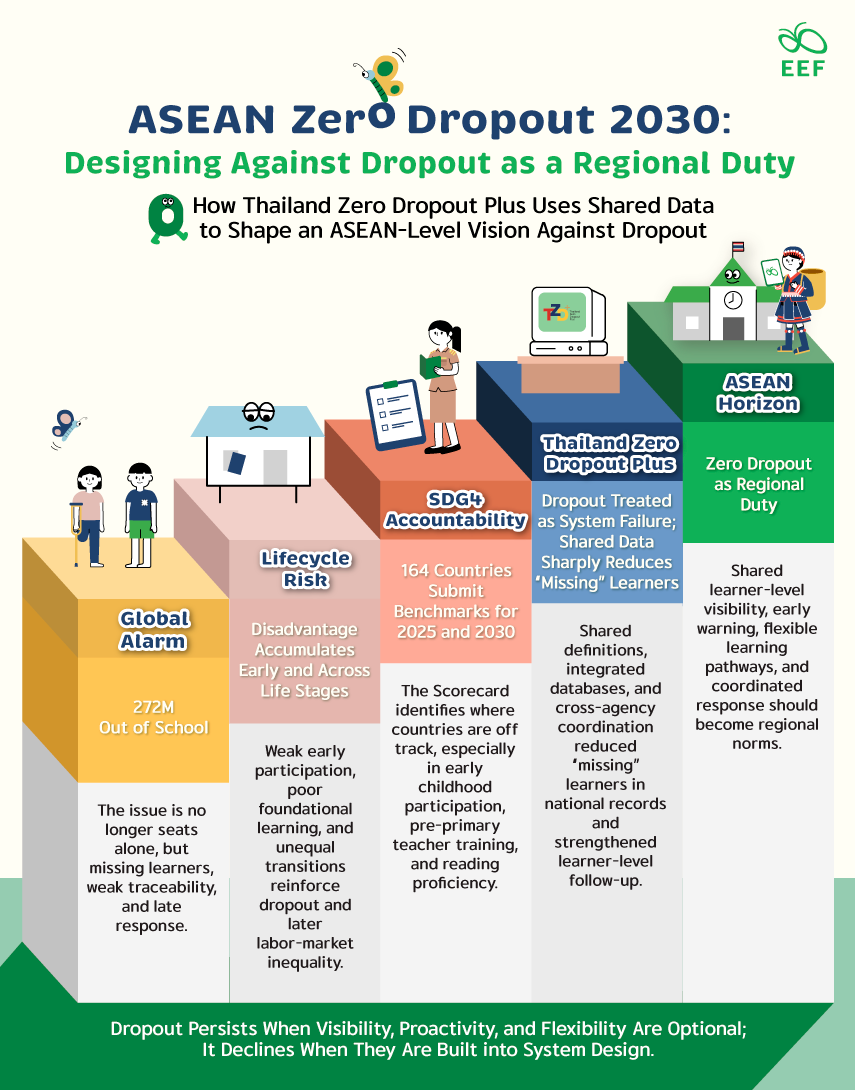
This design philosophy directly shapes Thailand’s four‑year roadmap (2026–2029), which extends the TZD+ data methodology to three distinct operational brackets: children aged 2–3 to prevent early institutional exclusion, children and youth aged 3–18 who are already out of school and require immediate flexible learning arrangements, and young people up to age 25 who are currently not in education, employment, or training (NEET). By utilizing its ASEAN Chairmanship in 2028, Thailand aims to champion a collective regional commitment to “ASEAN Zero Dropout 2030” under the banner “All for Education, Education for All.” Supported by robust data interoperability and early warning triggers, this agenda seeks to transform local visibility into an enduring regional public good.
Source: