

How EEF’s (Thailand) iSEE Turns National Data into Early Visibility for Children at Risk of Exclusion
iSEE is a solution to the OOSCY targeting challenge that turns system‑level out‑of‑school children and youth data into specific, up‑to‑date learner‑level records, instead of aggregate counts of vulnerable children alone, within EEF’s (Thailand) Education Security System.
The global out-of-school children and youth (OOSCY) crisis is fundamentally a problem of identification and timing. While the United Nations Educational, Scientific and Cultural Organization (UNESCO) estimates that 272 million children and youth remain excluded from classrooms worldwide, most national systems lack the diagnostic capacity to pinpoint vulnerable individuals early enough to stage a meaningful intervention. For the Equitable Education Fund (EEF) Thailand, data functions as vital public infrastructure. By integrating disparate national datasets into a unified tracking platform, the Information System for Equitable Education (iSEE) links early warning signals directly to targeted equitable financing policies, such as scholarship and support programs channelled to the learners most at risk. This model demonstrates that closing the data identification gap is a mandatory prerequisite to closing the broader educational access gap.
OOSCY as Global Problem: Learning from International Data Systems
Risks of student disengagement accumulate silently across socioeconomic axes—including household instability, deep poverty, and geographic isolation. Without connected, real-time monitoring, student dropouts are typically detected only after the students have already left the system. A recent IIEP-UNESCO study highlighted that conventional education frameworks suffer from fragmented databases and weak cross-agency coordination. True system resilience requires continuous localized monitoring paired with clear escalation pathways. Globally, advanced frameworks are demonstrating how data can be successfully weaponized for equity:
- South Africa: The South African Systemic Evaluation (SASE) links national reading and mathematics assessments with localized learner and school metadata, allowing provincial and district administrators to diagnose root-cause drivers of exclusion rather than merely tracking outcomes.
- Senegal: The Professional Practice Analysis and Support Approach digitizes qualitative classroom data, turning traditional school inspections into collaborative feedback loops between school leaders and teachers to fix instructional vulnerabilities before students disengage.
Thailand’s iSEE: From Estimation to Direct Targeting
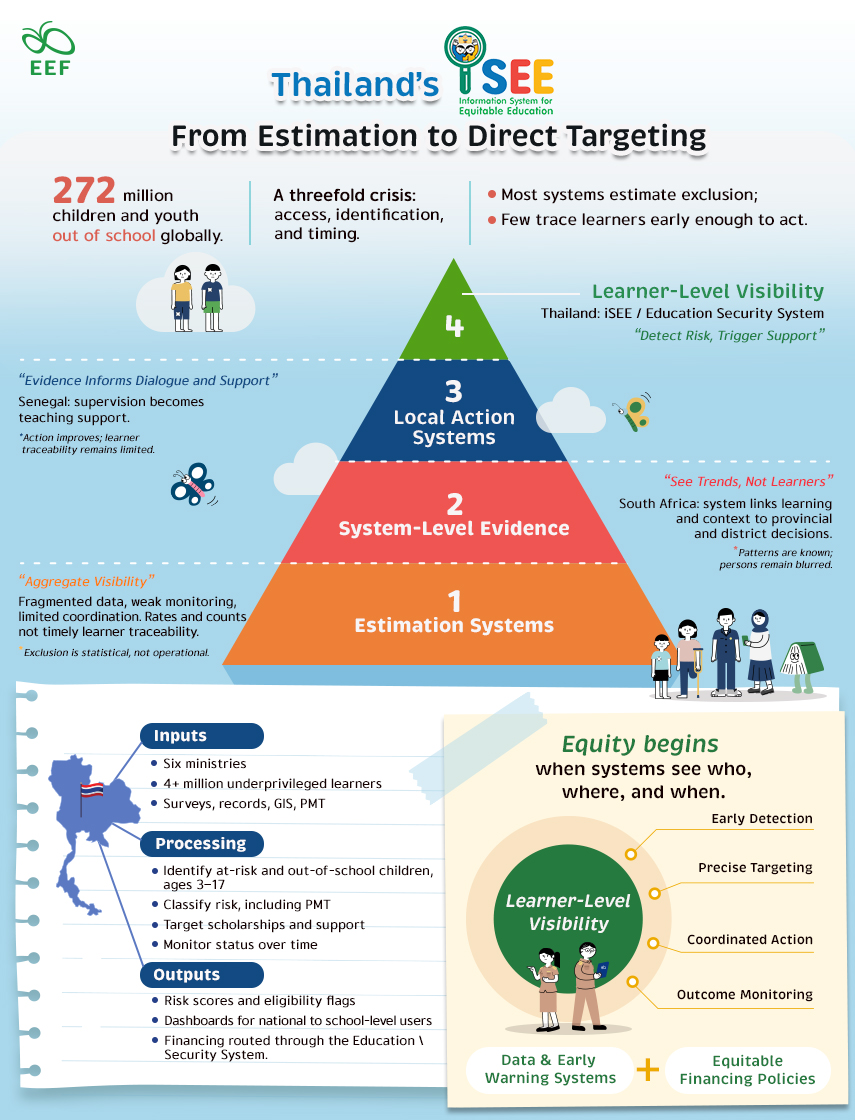
While traditional estimation frameworks treat educational exclusion as a purely statistical metric, Thailand’s iSEE platform creates an actionable ecosystem that maps individual risk in real time. The platform integrates administrative records, geospatial indicators (GIS), and socioeconomic screening tools—such as Proxy Means Tests (PMT)—to track over four million underprivileged school-age children. Unlike systems that rely on aggregate indicators, iSEE operates at the learner level, and this allows repeated identification across time and alignment between national data and local response.

Moving Beyond Enumeration: Creating Self-Improving Schools Beyond Thailand
The strategic strength of the iSEE pipeline lies in its deep integration with local delivery channels through the EEF’s comprehensive Education Security System. Rather than allowing data to sit dormant on centralized administrative dashboards, iSEE funnels real-time risk profiles directly to frontline school management software. This data pipeline actively fuels whole-school system initiatives like the Teacher and School Quality Program (TSQP)—now extended as the Teacher and School Quality Movement (TSQM), a nationwide self‑improving school movement aimed at zero dropout. By arming local educators with precise, diagnostic insights on student vulnerability, classroom practices can be adapted dynamically to prevent dropout before it occurs.
As Thailand prepares for its 2028 ASEAN Chairmanship, this mature data architecture serves as the operational blueprint for the regional ASEAN Zero Dropout 2030 commitment, proving that true lifelong learning begins when a system builds a precise, data-driven bridge back to the classroom for every single child.
Source: