

How EEF (Thailand) Positions “Equity by Design” as a Path to Recovery
Equity by Design is EEF (Thailand)’s approach to configuring educational systems so that financing, provision, and data only prioritize learners at highest risk of exclusion as systems expand.
The global education crisis is no longer primarily a question of access; it is increasingly a question of retention. Drawing on UNESCO’s Global Education Monitoring (GEM) Report 2026, the challenge can be understood as a widening imbalance between system expansion and learner exclusion: progress and exclusion are now scaling in parallel, resulting in a growing mismatch between the pace at which systems expand and their capacity to retain, re-engage, and support vulnerable learners. Against this backdrop, the Equitable Education Fund (EEF) Thailand offers a practical example of policy integration, targeted financing, and learner-centered system design.
Why This Moment Matters: A Crisis That Expands with Progress
Approximately 273 million out-of-school children and youth (OOSCY) were recorded in 2024—one in six of the global school-age population—marking the seventh consecutive annual increase. This trend persists despite substantial educational expansion: since 2000, primary and secondary enrollment has grown by 327 million learners, pre-primary participation by 45%, and tertiary enrollment by 161%. However, at current rates, a 95% upper-secondary completion rate will not be achieved until 2105, placing the SDG4 target well beyond reach in an increasingly VUCA world. UNESCO identifies three structural pressures behind this gap:
- Demographic Growth: Concentrated heavily in regions like sub-Saharan Africa.
- External Disruptions: Conflict and climate-related school closures, particularly in the Middle East.
- System Design Limitations: Insufficient capacity to retain, re-engage, and support marginalized learners.
Pathways to Recovery: From Isolated Policies to Policy Ecosystem
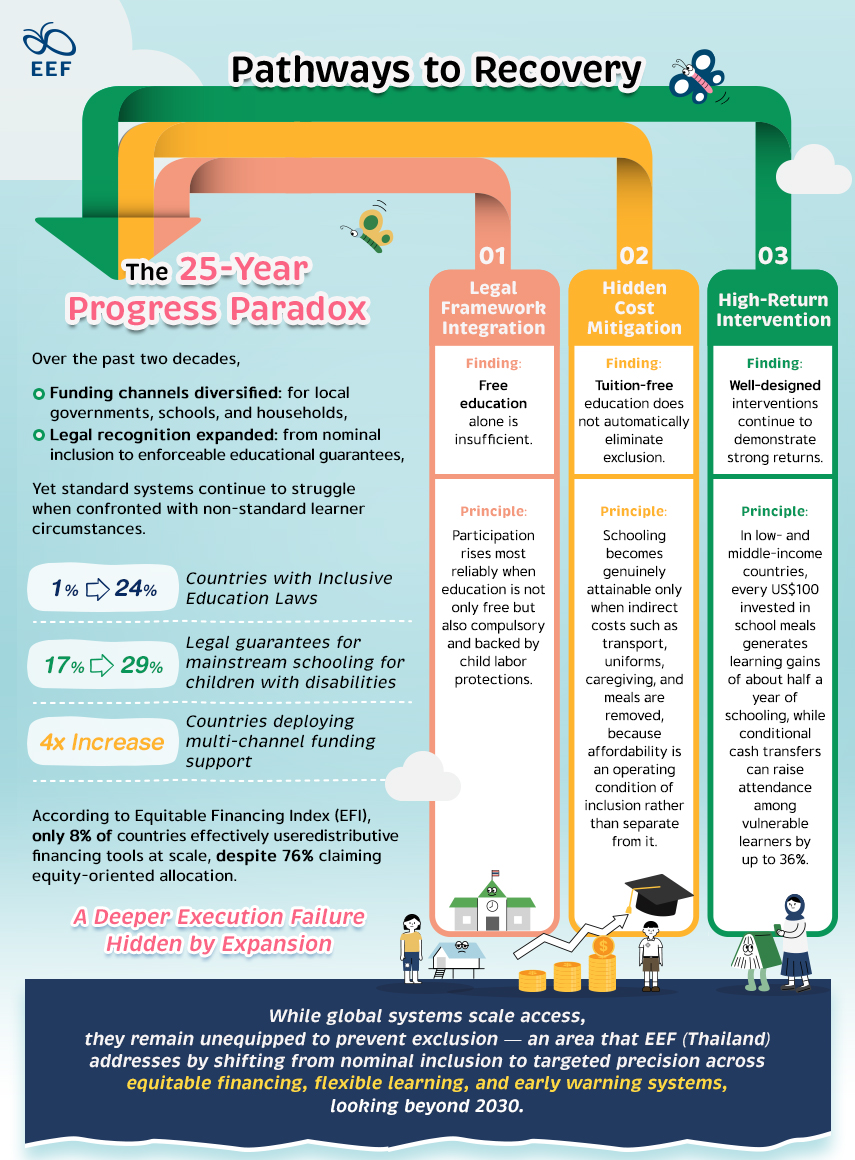
Although legal protections have expanded considerably over the past 25 years, implementation continues to lag. Many systems still attempt to accommodate diverse learner realities through rigid frameworks that lack effective redistributive mechanisms, creating a stark gap between legislative intent and institutional reality.
EEF Thailand: From Global Metrics to Country Stories
While global systems scale access, they remain unequipped to prevent exclusion—a design flaw EEF (Thailand) addresses by shifting from nominal inclusion to targeted precision across equitable financing, flexible learning, and early warning systems, looking beyond 2030. To reduce the conditions that produce exclusion across the whole school system and safeguard national human capital, the EEF’s approach rests on three interconnected design principles:
- Precision Targeting: Identify vulnerable learners via integrated cross-agency databases for dynamic, needs-based resource allocation, operationalized. This is operationalized through the Conditional Cash Transfer (CCT) poverty-screening system and the Information System for Equitable Education (iSEE), which jointly identify learners from the poorest households and drive equity-based budgeting at scale.
- Cross-Sector Linkage: Connect education support with social protection, local governance, and community actors to eliminate administrative fragmentation. This mechanism is anchored in the Education Security System and multi-stakeholder initiatives such as Thailand Zero Dropout Plus (TZD+) and Learning Coin.
- Cost Barrier Removal: Fund both tuition and indirect costs to improve student retention. This is achieved through nationwide CCT and Equity Fund scholarships under the Education Security System, alongside innovative financing mechanisms that convert private capital into targeted support for school supplies, transport, and living costs for learners from the poorest households.

Toward Recovery: Designing for the Last Mile First
Closing the final enrollment and completion gaps requires three distinct operational shifts:
- Metrics: From expansion metrics to completion and continuity metrics.
- Provision: From universal distribution to targeted inclusion based on individual vulnerability.
- Governance: From isolated sectoral policies to integrated system design.
Within this trajectory, the EEF offers a testable reference point for whether a middle-income country can embed equity directly into domestic financing before exclusion patterns become entrenched. And this question extends beyond Thailand: as UNESCO’s Countdown to 2030 enters its final phase, the broader challenge is whether educational systems can continue expanding without reproducing the very inequalities they seek to overcome—to which Thailand’s approach offers one possible answer.
As the country moves toward its 2028 ASEAN Chairmanship, this domestic architecture also provides the foundation for an ASEAN Zero Dropout 2030 commitment, transforming a national effort into a regional framework for action.
Source: