

How Scarce Public Budgets Can Still Keep the Most Vulnerable Learners in School
Targeted equity financing is the explicit and traceable use of finite education budgets to prioritize learners in greatest need, and only insofar as it remains within a broader mandate to reduce educational inequality system‑wide.
Low-income countries have long financed public education from a chronically inadequate and shrinking resource base. Today, escalating debt burdens and stagnating foreign aid threaten to further erode the fiscal space required to protect children from the poorest households. For the Equitable Education Fund (EEF) Thailand, the policy signal is clear: safeguarding educational equity must depend less on broad expenditure growth and more on sharper, targeted budget design that intercepts vulnerable learners before exclusion becomes a permanent economic loss.

A Financing System Under Strain: When Need Rises Faster Than Commitment
The 2025 Global Education Monitoring Report estimates 272 million out-of-school children and youth (OOSCY) worldwide—a surge driven by updated demographic data, stalled structural progress, and historical undercounting in conflict-affected regions like Myanmar, Sudan, and Somalia. Compounding this crisis, governments are actively retreating from previous funding commitments. Since 2015, average public education spending has dropped by up to 0.4 percentage points of GDP and 0.7 percentage points of total public expenditure, with middle-income nations experiencing contractions as high as 2 percentage points. Currently, 34% of countries fail to meet either the baseline benchmark of 4% of GDP or 15% of public expenditure. Consequently, educational systems are losing legislative budget protections precisely when student vulnerability is accelerating.

Low-Income Country Exposure: When Limited Public Budgets Leave Learners Unprotected
Where governments fail to invest, vulnerable families pay the price. In lower-middle-income countries, private households are forced to shoulder roughly 40% of total education costs. This heavy private burden is exacerbated by systemic debt: interest payments absorb 43% of per capita education budgets in low-income states and 48% in lower-middle-income states, aggressively diverting resources away from classrooms. To prevent complete human capital collapse, countries operating with minimal fiscal room must deploy redistributive expenditure strategies that deliberately shield children who cannot compensate for state absence through household income, private tutoring, or digital connectivity.

Aid Under Retrenchment: When External Funding Becomes Smaller and Less Predictable
International aid no longer serves as a reliable counter-weight. Education has steadily fallen down donor priority lists since 2016, and the share of basic education funding within total education aid dropped from 40% to 30% by 2023. Recent data shows a sharp 12% drop in education aid, with announced donor cuts projected to slash funding by an additional 14% by 2027—an overall contraction of about one quarter in a VUCA world where volatility is now a core planning condition. For vulnerable learners, this fragmentation means that external programs are becoming less predictable and less capable of sustaining long-term systemic interventions.
Education on the Edge: When Budget Rules Push Learning to the Periphery
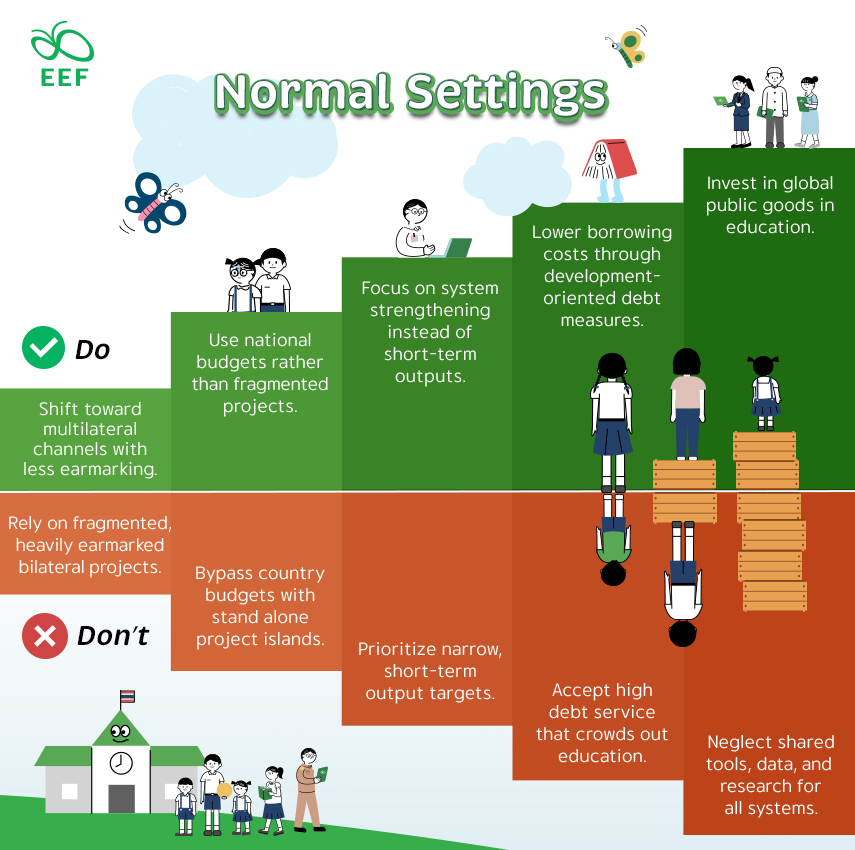
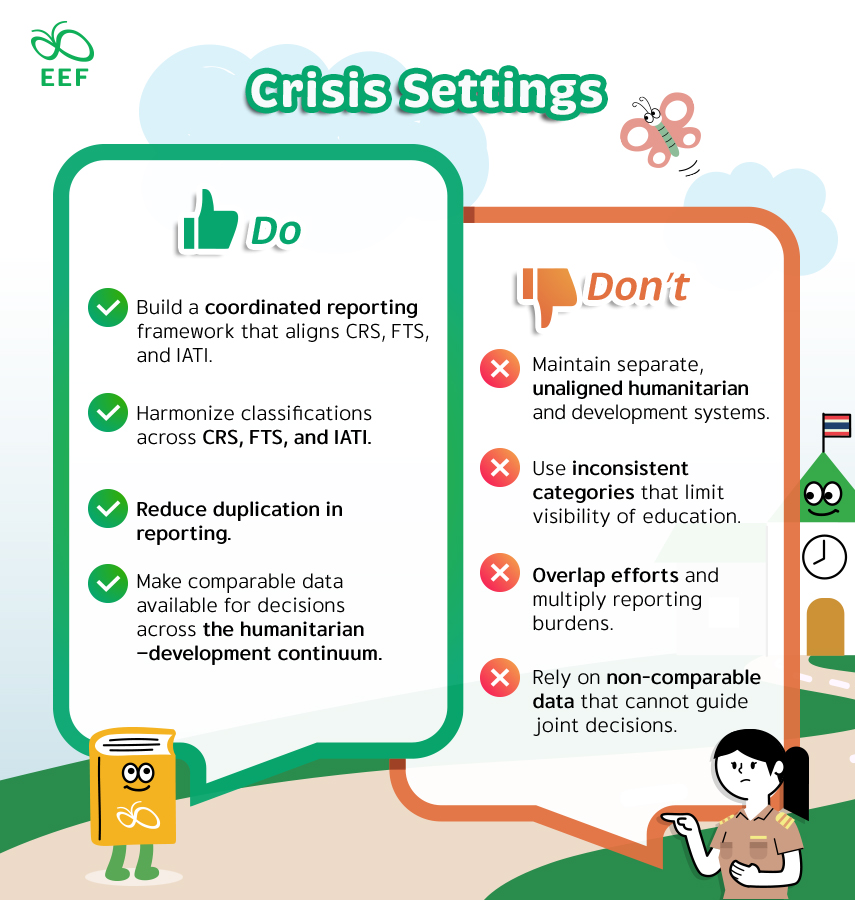
Historically, education has been structurally disadvantaged in international finance. It frequently ranks below health and energy in donor allocations, depends heavily on grants, and fits poorly into rigid, results-based aid models. However, out of necessity, the architecture of this funding is shifting toward crisis response; the share of education-in-crises funding channeled through development aid surged from 70% in 2017 to 92% in 2023. To optimize these fluctuating resources, policymakers must adopt distinct operational protocols for both stable and emergency settings:
Spending for Those at Risk: When Equitable Financing Keeps Vulnerable Students in School
When global out-of-school numbers rise and international aid contracts, the primary policy lever must shift from aggregate spending to targeted allocation. For the EEF (Thailand), this global data reinforces a core domestic principle: equity financing works best when it is intentional, traceable, and legally linked to identifiable learner risk.
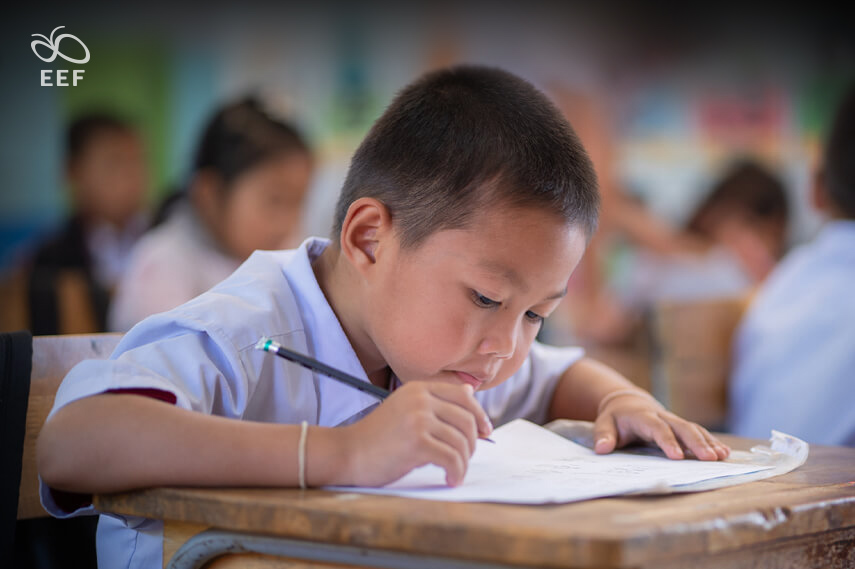
This targeted model serves as the operational engine of Thailand’s Equitable Education Act of 2018. In practice, the EEF (Thailand) utilizes need-based rules to bypass traditional institutional bottlenecks, sending support directly to individual high-risk students. By pairing this funding with integrated information systems, the country can instantly map who is receiving help, who is being left behind, and where funds are stalling.
In an era of tightening fiscal constraints, the central policy question is no longer whether countries can simply spend more, but whether they can direct what they have with enough diagnostic clarity to keep the most vulnerable children in school through equitable financing policies that remain viable while looking beyond 2030.
Source: https://www.unesco.org/gem-report/en/education-finance