
How EEF (Thailand) Leverages Public-Private-Youth Alliances to Close the 210-Million EAP Jobs Gap
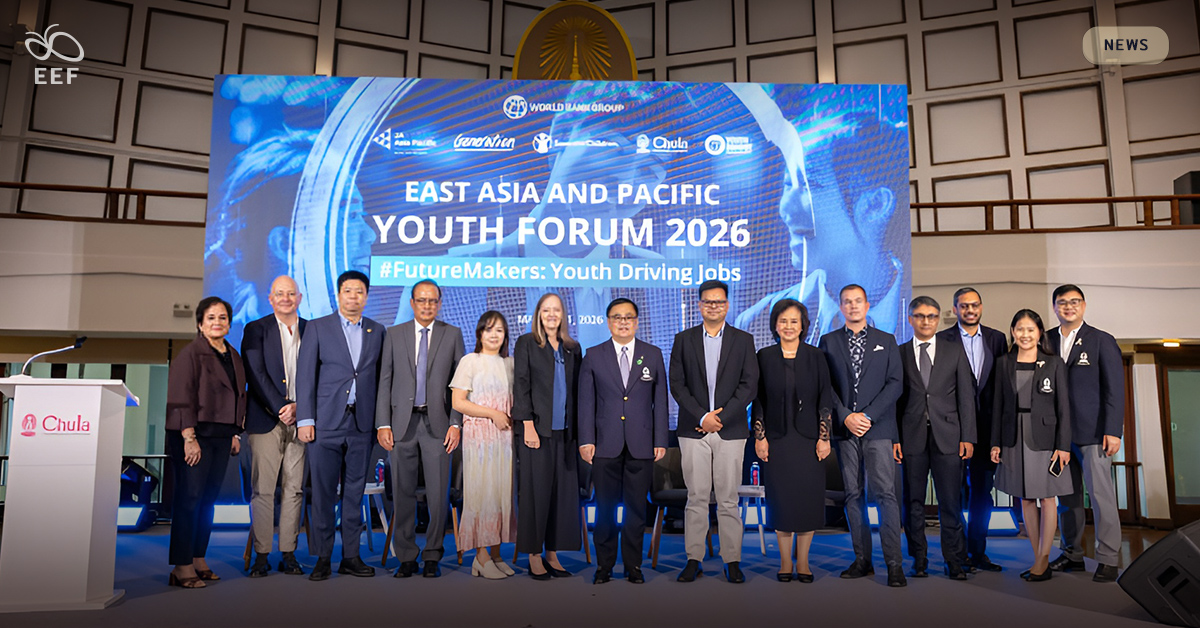
The East Asia and Pacific (EAP) Youth Forum 2026, held under the theme “#FutureMaker: Youth Driving Jobs,” was organized by the World Bank Group at Chulalongkorn University. This landmark event convened youth leaders, policymakers, educators, and private sector representatives to establish collaborative public-private frameworks, with the primary aim to promote lifelong learning, realign workforce skills with real-time labor market demands, and build a resilient safety net for vulnerable youth facing digital transformation risks.
Dr. Kraiyos Patrawart, Managing Director of the Equitable Education Fund (EEF) Thailand, was invited to the forum to address a looming labor inequality crisis: an estimated 210 million young people across the EAP region facing unemployment risks driven by economic volatility and rapid digitalization. The Managing Director presented an integrated operational framework, emphasizing the critical role of “co-design” with youth to transform these disruptions into equitable career opportunities.
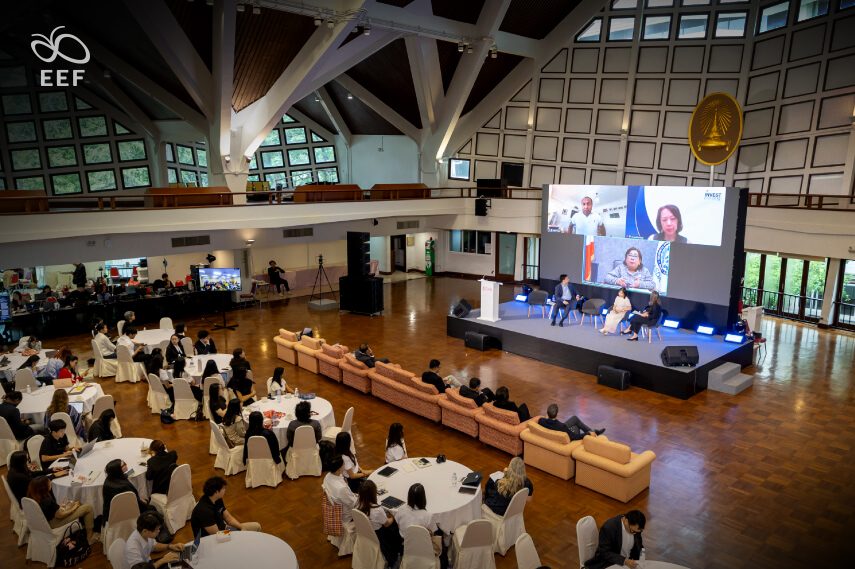
The EAP Youth Forum 2026 brought together a diverse coalition of development partners. Key representatives from the World Bank Group included: Edith Chibono, Director of Regional External Affairs, Communications and External Relations; Habib Nasser Rab, Practice Manager of Prosperity; Melinda Good, Division Director for Thailand and Myanmar; and Naomi Adams, Manager of Stakeholder Engagement, Communications and External Relations.
Crucial policy perspectives were provided by Rosanna A. Urdaneta, Deputy Director General for Policies and Planning of the Philippines’ Technical Education and Skills Development Authority (TESDA); and Dato’ Loo Lee Lian, Chief Executive Officer of Invest Penang, Malaysia.
Academic and educational insights were led by Prof. Dr. Wilert Puriwat, President of Chulalongkorn University; and Dr. Kraiyos Patrawart, Managing Director of Thailand’s Equitable Education Fund, while the private sector was represented by industry innovators Promporn Mook Chaichirawiwat, Country Manager of Thinking Machines, Thailand; and Kori Chan, Managing Director of TWM Group, Papua New Guinea.
Facing the 210-Million Jobs Gap: A Major Challenge for Workforce Development
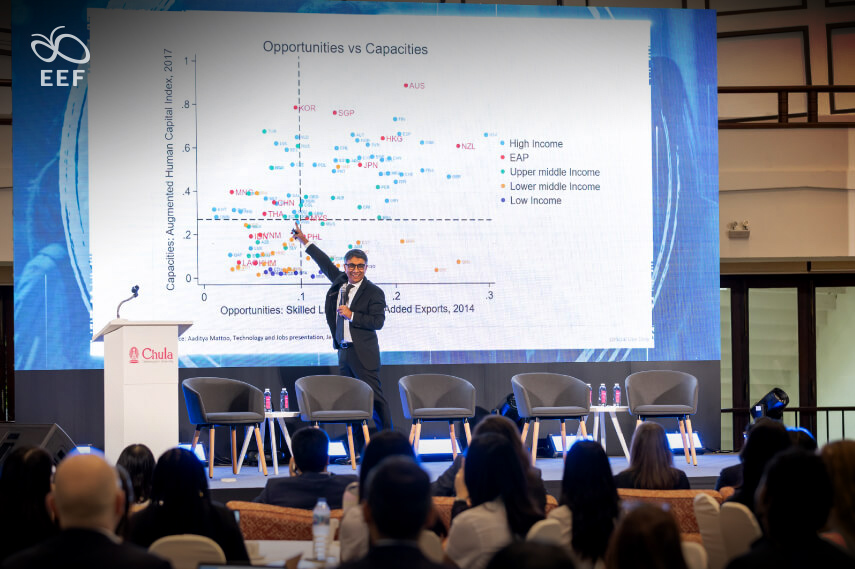
The EAP region has achieved historic strides in poverty reduction over the past 3 decades, yet that momentum now faces a critical inflection point due to slowing economic growth, rising debt, declining investments, and global shocks. The scale of the crisis facing the region is staggering: over the coming decade, roughly 320 million young people will reach working age, yet current projections suggest only 110 million jobs will be created, leaving a daunting gap of 210 million opportunities that threatens to stall regional growth and deepen economic inequality.
Compounding this challenge is the accelerating pressure of technological advancement, particularly Artificial Intelligence (AI), which simultaneously generates and displaces employment across a 4-quadrant matrix of physical versus cognitive, and routine versus non-routine, labor. Because a large portion of the regional workforce remains concentrated in urban service industries that rely heavily on physical and routine tasks, vulnerability to technological disruptions is severe. While smart robotics and automation have already displaced approximately 1.4 million low-skilled workers across the region, the capacity for remaining workers to leverage AI for upskilling and augmenting their productivity continues to lag behind.
Rather than fragmented interventions, navigating this transition demands an integrated, holistic policy framework that embeds lifelong learning directly into the structural development of education and labor systems. This is crucial to building systemic resilience among youth and the workforce, ensuring they keep pace with future global shifts.
Restructuring the Education-to-Employment Pathway
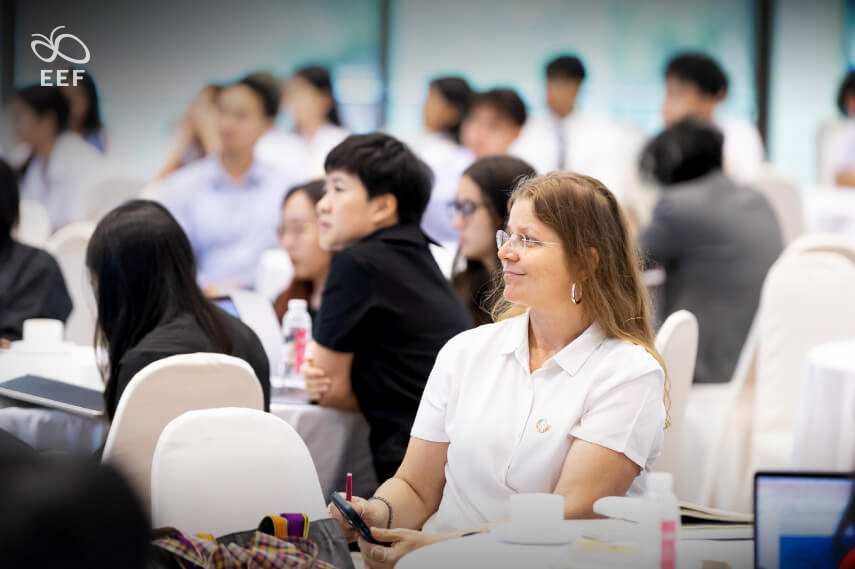
This integration requires a structural rethinking of the relationship between education and employment: rather than treating them as two separate stages, they must be seamlessly integrated into a synchronized pathway, transforming learning environments into “open testing grounds” that evolve alongside industry demands. In an era of exponential generative AI advancement, it is glaringly evident that traditional, multi-year academic curricula can no longer keep pace with a business landscape that undergoes disruptive transformations every 1-2 years.
To avoid preparing students for obsolete industries, the public sector and educational institutions must become more agile. This involves accelerating curriculum development, integrating stackable micro-credentials, and deeply embedding the private sector into the educational design process from its inception.
Concurrently, the private sector can bridge the practical execution gap by providing students with hands-on, real-world experiences while they study. This includes internships, work-based learning, and collaborative hackathons designed to cultivate critical thinking, on-the-spot decision-making, and the ability to effectively evaluate AI outputs. Ultimately, the shared goal of both public and private entities is not to produce individuals with rigid, static skills, but to collaboratively foster dynamic lifelong learning that empower youth to navigate future changes.
Bending the System Toward the Learner
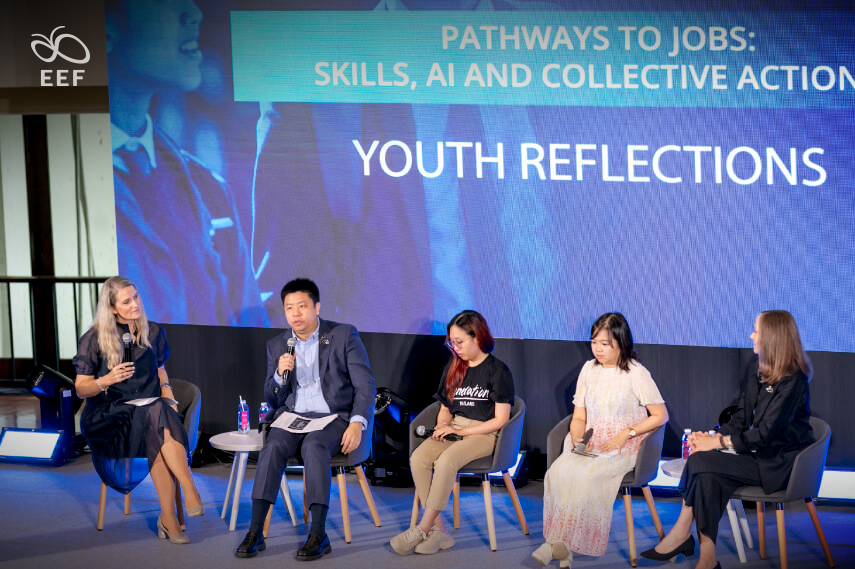
During the panel discussion, Dr. Kraiyos Patrawart emphasized reducing educational inequality through localized, flexible, and deeply empathetic public sector interventions. He argued that modern frameworks must move beyond reducing youth to mere units of human capital, prioritizing instead a holistic approach to human development. To support out-of-school children and youth from highly vulnerable, low-income households unable to pursue traditional four-year paths, the EEF (Thailand) has driven the pioneering High Vocational Innovation Scholarship programs. These short-term, targeted tracks—such as one-year certificate programs for practical nursing and dental assistance—act as vital economic springboards. They enable disadvantaged youth to immediately earn living wages, secure foundational skills for a digital labor market, and retain the flexibility to re-enter higher education later in life.
“The commitment of the EEF (Thailand) and our coalition partners is to make the educational system fundamentally more flexible. We need to treat our learning environments as sandboxes. If a young person fails, the system should allow them to fail fast, get back on their feet faster, and step into the labor market with genuine confidence,” stated the Managing Director.
Achieving this vision requires a decisive shift in mindset toward genuine “co-design.” Youth must no longer be treated as passive beneficiaries or merely invited to listen to policies that adults have already determined; instead, policymakers must ask with radical honesty whether existing systems truly prepare young people for tomorrow’s challenges. Leaders must transition from “thinking for youth” to “listening directly to them,” identifying where systems succeed and where gaps persist. Ultimately, the learning ecosystem must be structurally designed to be flexible and learner-centric, rather than forcing the learner to bend to a rigid system.
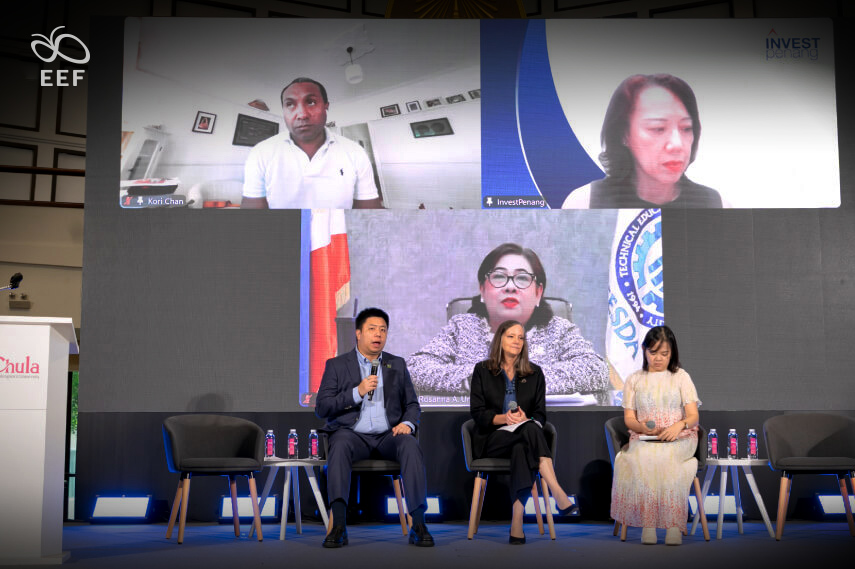
To drive this vision of flexible learning ecosystems and inclusive public-private sandboxes that transform labor market volatility into equitable opportunities for vulnerable youth, the EEF (Thailand) extends an open invitation to global networks, grassroots organizations, and educational stakeholders. Join forces to exchange data-driven insights, share knowledge, and collectively advance regional equity initiatives to forge lasting, systemic change.


