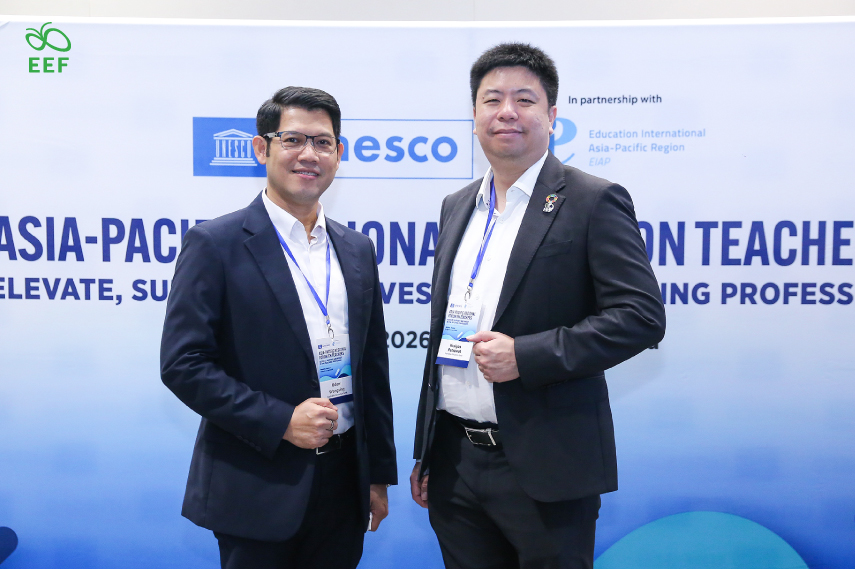
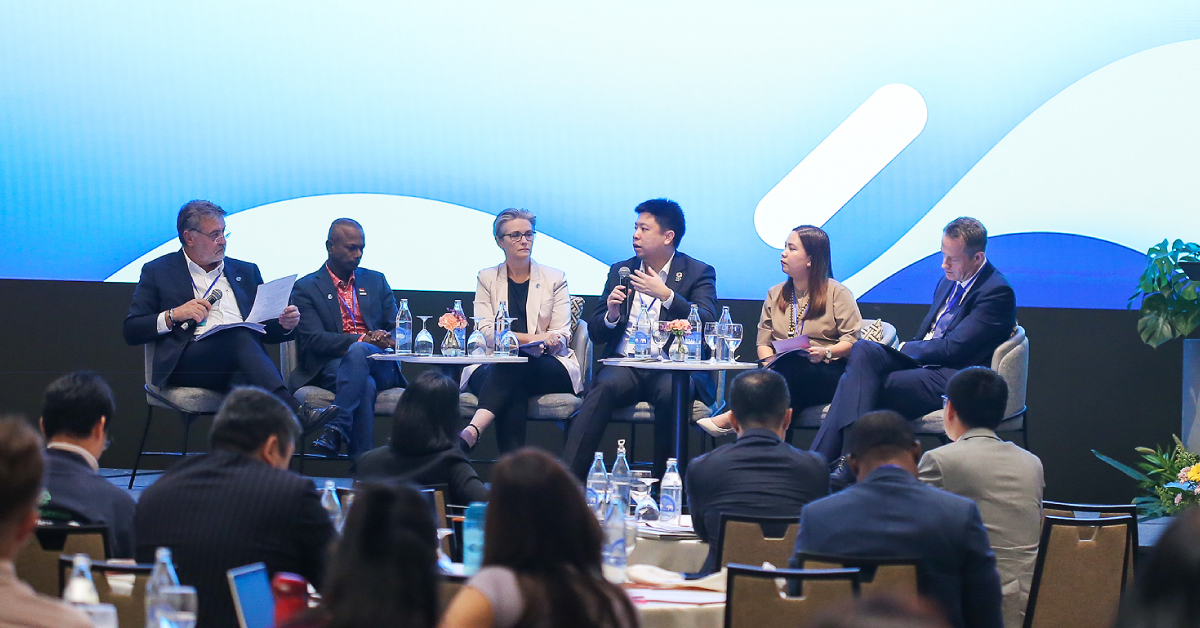
As the UNESCO-led Asia-Pacific Regional Forum on Teachers continues its proceedings from March 31 to April 2, 2026, at the Avani Sukhumvit Bangkok Hotel, global education leaders are tackling a massive, systemic crisis in the teaching profession. During the Plenary Session, moderated by Angelo Gavrielatos, Go Public Fund Education Campaign Manager, Education International Asia-Pacific, the focus was laser-targeted on building a diverse and dynamic teacher workforce through a lens of inclusion, equity, and gender equality.
Representing Thailand, Dr. Kraiyos Patrawart, Managing Director of the Equitable Education Fund (EEF) Thailand, and Dr. Udom Wongsing, Director of the Office of Teachers and School Development, participated in the knowledge-sharing session at the forum. Dr. Kraiyos took center stage to present the “Homegrown Teachers” initiative—an evidence-based approach to solving the chronic teacher shortages plaguing the nation’s most remote and vulnerable communities in Thailand.
The Crisis in Thailand’s “Protected” Schools
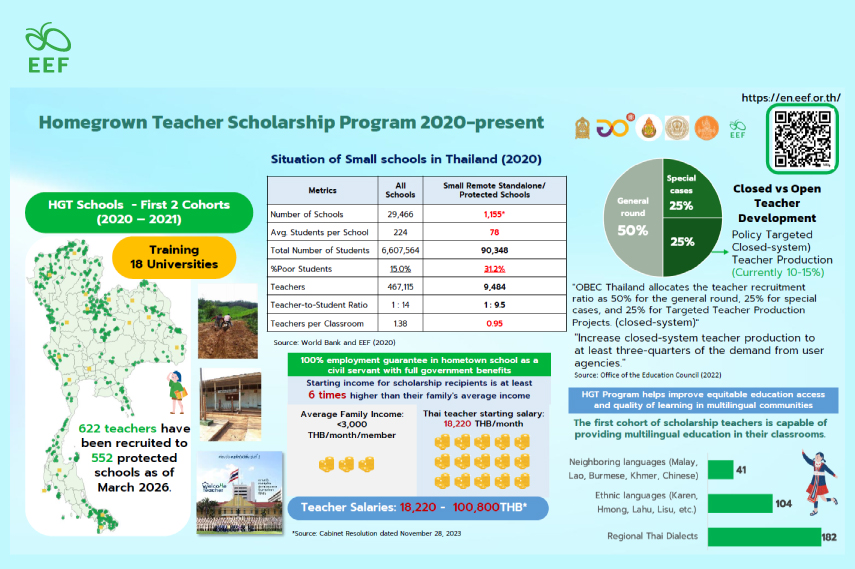
Dr. Kraiyos outlined the stark realities of education in Thailand’s remote areas. Research data conducted by the World Bank and Equitable Education Research Institute (EEFI), EEF (Thailand), in 2020 found 1,155 “small protected schools” in Thailand that cannot be consolidated. While these schools benefit from a smaller teacher-to-student ratio (1:9.5 compared to the 1:14 national average), they suffer from a critically low teacher-per-classroom ratio of just 0.91, compared to 1.38 in all other schools.
Compounding this issue is geographic isolation and rapid turnover. “From the map, you can see most small protected schools are near the border areas,” Dr. Kraiyos explained. Frequently, teachers from the cities are assigned to these hardship posts, but they reliably request transfers and move out of these schools after 2 years.
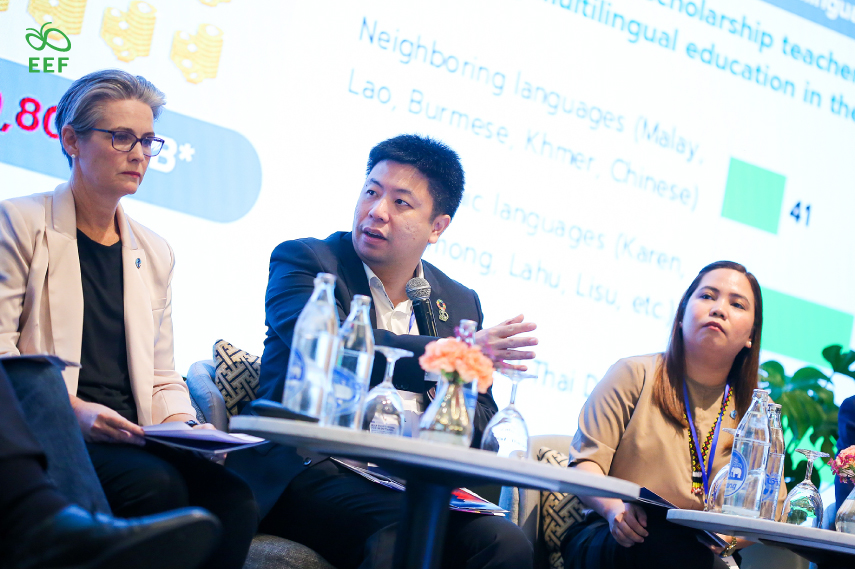
The “Homegrown” Solution: Eradicating Poverty in One Generation
To permanently fill the gaps of missing teachers in these small protected schools, the EEF utilizes a “closed system” of teacher production, aiming to source up to one-quarter of teacher-students through this specialized pipeline.
The Homegrown Teachers program specifically targets scholarship students from the poorest families within these local communities. As these teacher schools are located close to the small protected schools, these institutions inherently understand the culture and context of the schools and communities the student-teachers will be assigned to. Furthermore, Dr. Kraiyos highlighted the profound socio-economic impact of this initiative: securing a higher teacher salary allows these scholarship students to eradicate poverty for their families within a single generation. Looking to the future, the EEF hopes to expand this support to include other specializations, such as special education, in its next phase.
Demographic Shifts and the Need for Sustained Political Will
Looking ahead, Dr. Kraiyos warned of upcoming demographic challenges. Thailand is rapidly becoming an ultra-aged society, with a shrinking young population and a growing elderly one, which threatens to decline the teaching profession as government budgets become increasingly competitive.
To combat this, he emphasized the critical need to strategize teacher production for both pre-service and in-service training over the next 5 to 10 years. The EEF is preparing to survey teachers on the excessive administrative hours they work outside of teaching, which will be proposed directly to the new Minister of Education. Above all, Dr. Kraiyos stressed that teacher policy requires a continuation of political will to survive routine political turnover in the Thai government.
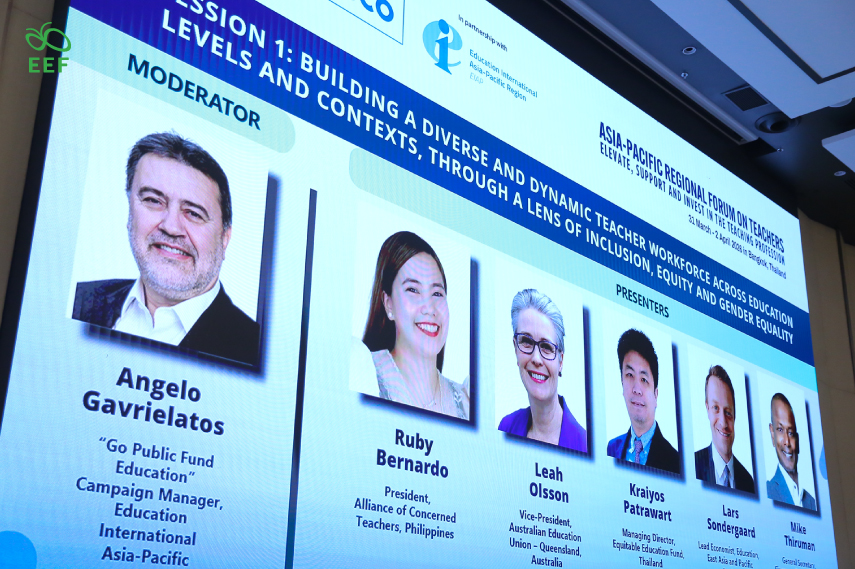
Dr. Kraiyos was joined by a distinguished panel of international representatives, who echoed his sentiments and praised the EEF’s approach as a model for the region.
- Lars Sondergaard, Lead Economist, Education, East Asia and Pacific Region, World Bank:
Sondergaard noted that quality education is the highest expenditure for Ministries of Finance, yet most middle-income countries in the Asia-Pacific region do not even spend 4% of their GDP on education. He argued that governments must shift their dialogue from inputs to outcomes, treating education not as consumption, but as a critical investment. Sondergaard specifically commended Dr. Kraiyos’s work, stating that governments want evidence-based programs so that Ministries of Education can justify budgets to Ministries of Finance, citing the EEF’s project as a prime example of this success. He urged nations to treat initial teacher training as “national infrastructure”.
- Ruby Bernardo, President, Alliance of Concerned Teachers (ACT), Philippines:
Representing the Philippines, Bernardo painted a dire picture of a 147,000 teacher shortage, noting that 9 out of 10 teachers earn below a living wage and are severely overworked by additional roles. She stressed that the global teacher shortage is not an accident but a result of policy, demanding that investment in teachers must be “real and tangible”.
- Leah Olsson, Vice-President, Australian Education Union (AEU) – Queensland, Australia:
Olsson revealed that over three-quarters of schools in Australia are currently understaffed. According to their data, 56% of teachers cite massive workloads as the main reason they plan to leave the profession. She delivered a powerful reminder to the forum: “Teaching conditions equal learning conditions. Otherwise, schools are just buildings”.
- Mike Thiruman, General Secretary, Singapore Teachers Union (STU), Singapore:
Thiruman stated bluntly that the current situation is a “crisis of political will”. Drawing from Singapore’s successful model of fully paying students while they study to become teachers, he emphasized that burnout should never be normalized or taken for granted by society. He left the forum with a framework of four critical priorities: wages, work prospects, wellbeing, and the necessity to work directly with teachers.
Looking Forward
The session underscored the core theme of the recently launched 2026 Global Education Monitoring (GEM) Report regarding equity and inclusion. By sharing the successes of the Homegrown Teachers initiative, Dr. Kraiyos demonstrated that resilient, sustainable, and highly localized workforce planning is the most effective blueprint for securing the future of education in Thailand and across the Asia-Pacific.