
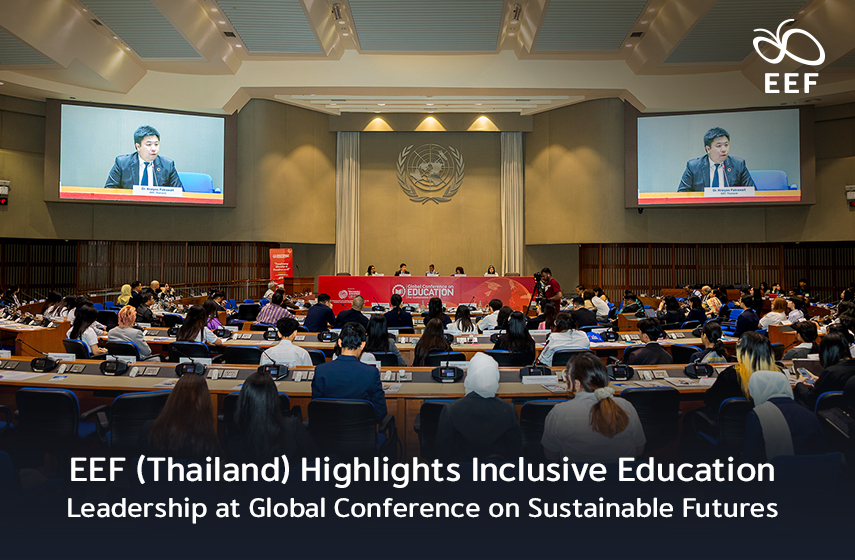
EEF (Thailand) Highlights Inclusive Education Leadership at Global Conference on Sustainable Futures
Bangkok, Thailand — Dr. Kraiyos Patrawart, Managing Director of the Equitable Education Fund (EEF) Thailand, was invited as a panel speaker at the Global Conference on Education for a Sustainable Future, held on February 11, 2026, at the United Nations Conference Centre. Convened by the Sustainable Development Council, the high-level forum gathered policymakers, academics, youth leaders, international organizations, and private sector partners from more than 20 countries to advance transformative education aligned with the 2030 Agenda for Sustainable Development and Sustainable Development Goal 4 (SDG4) on quality education.
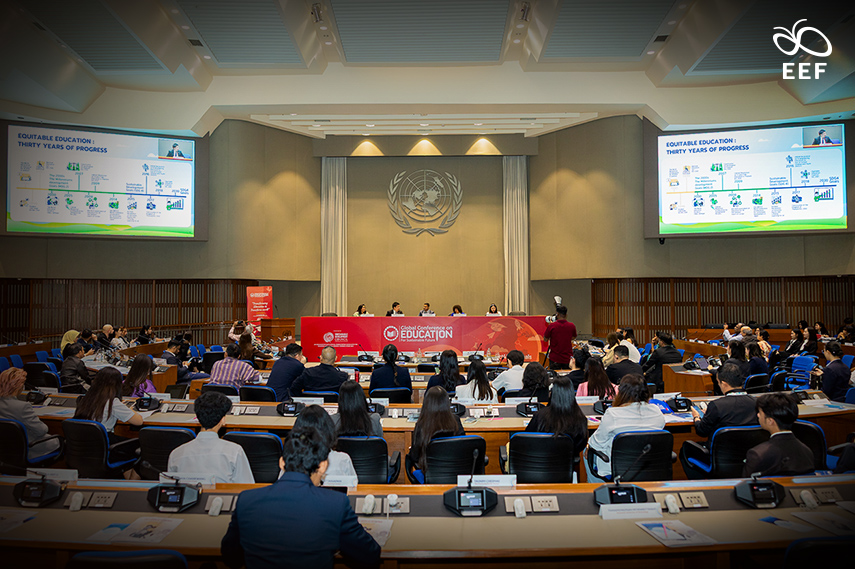
The panel discussion on “Inclusive and Equitable Education: Advancing the Principle of Leaving No One Behind” was moderated by Dr. Ajmal Dastagir, and featured speakers from diverse sectors addressing education reform, innovation, and social inclusion. Recent data from the United Nations and UNESCO underscore the urgency of the conference’s mission, with more than 272 million children and youth still out of school globally and nearly 754 million adults lacking basic literacy skills. Completion rates remain uneven across education levels, reflecting persistent inequality and structural barriers, particularly in low-income regions.
During the session, Pornpatima Woottisanwattana, Director of the International Relations Group of the Children and Youth Council of Thailand, presented youth-led survey findings on quality education in the 21st century. The results highlighted inflexible learning models, limited future-oriented skills development, and significant gaps in inclusive education for persons with disabilities. She proposed key pathways forward, including equal access to expanded free education, digital inclusion, youth employability initiatives, and the creation of safe learning environments.
Mansoor Ali Khan Abdul Buhari, Founder and CEO of E DADDY Holding, shared perspectives on inclusion through innovation, emphasizing women’s empowerment in education and the electric mobility sector. He illustrated how skills development in emerging technologies can foster economic independence, build sustainable ecosystems, and connect education directly to real-world opportunities. He also stressed the importance of public-private collaboration to ensure inclusive growth and equal access to opportunity.
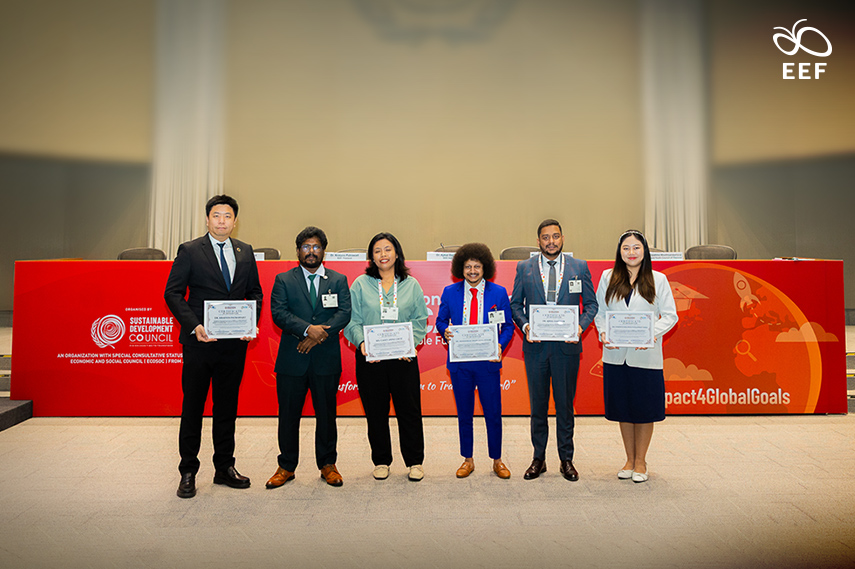
Taking center stage, Dr. Kraiyos outlined Thailand’s long-term movement toward equitable education, highlighting the All for Education and Education for All approach driven through the Equitable Education Alliance. He detailed how EEF (Thailand) has worked over the past eight years to reform education systems through flexible, evidence-based interventions focused on the most vulnerable children and youth. A key emphasis was the Thailand Zero Dropout initiative, designed to ensure no child is left behind while equipping young people with the skills needed for workforce readiness and national economic development. Dr. Kraiyos underscored that achieving equity requires collaboration from national to international levels, and active participation from governments, communities, and the private sector alike.
Casey Anne Cruz, Chairperson and Co-founder of KOMUNIDA, Inc., reinforced education as a public good and a fundamental human right. Her remarks focused on reaching marginalized learners, reducing systemic inequalities through human rights-based civic education, and positioning children and youth as co-creators in cross-sector governance. She also engaged young participants directly, encouraging them to make their voices heard in shaping inclusive education futures.
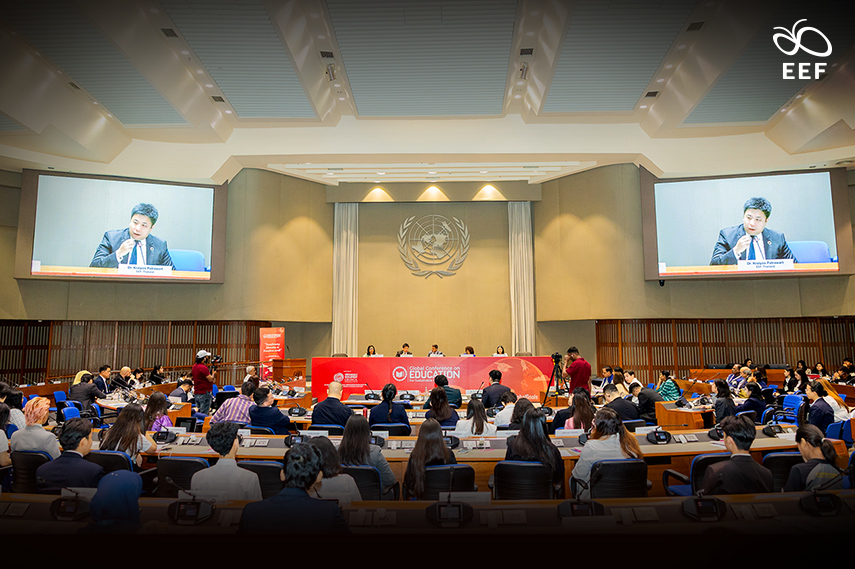
The panel concluded with policy-relevant insights and concrete examples to strengthen inclusive education strategies aligned with SDG4. Across the broader conference, expected outcomes include an International Declaration on Education for a Sustainable Future, a Policy and Academic Recommendations Report, the formation of a global research collaboration network, youth and educator commitments on sustainable learning practices, and the launch of thematic working groups for future joint initiatives.
EEF Thailand’s active role in the conference reaffirmed its position as a regional leader in advancing equitable, evidence-based education reform, contributing practical models for ensuring that quality learning opportunities truly reach every learner — leaving no one behind.


