
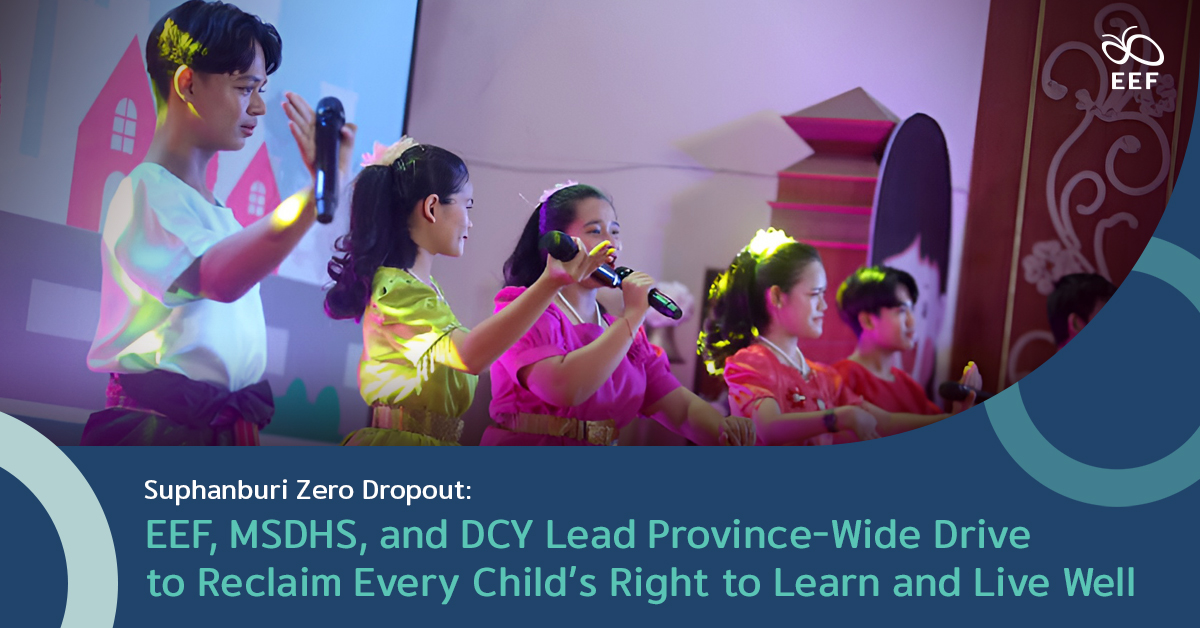
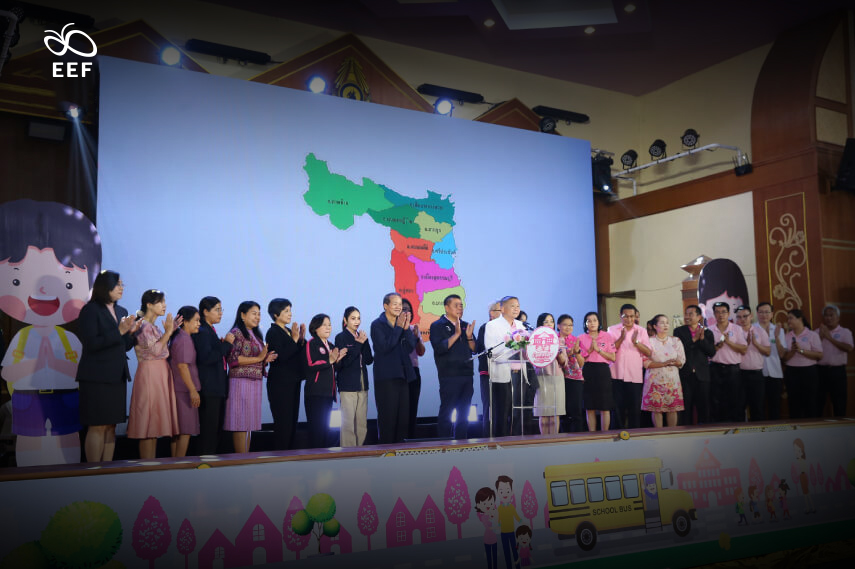
Suphanburi Province has made a bold and unified pledge: to eliminate school dropout for good. This commitment was reaffirmed at the 2025 “Suphanburi Zero Dropout” declaration ceremony, held during the fourth annual “Child-Friendly Province Expo” under the theme “This New Semester, Every Child Back to Class.” The declaration brought together a powerful coalition of key stakeholders, most notably the Ministry of Social Development and Human Security (MSDHS), the Department of Children and Youth (DCY), and the Equitable Education Fund (EEF) Thailand, and a robust network of local partners. Together, they voiced a shared resolve: no child left behind.
- Reintegration: Reintegrate out-of-school children through holistic support and practical, skill-based learning;
- Protection: Ensure safe, nurturing learning environments by strengthening safeguards in schools and early childhood centers;
- Retention: Keep students in school with targeted assistance and continuous care through compulsory and higher education;
- Innovation: Collaborate with partners to invest in research and create new pathways to equitable education for all.
Leading the charge stood Governor Piriya Chantadilok, chairman of the provincial Thailand Zero Dropout committee. With clarity and urgency, he unveiled a four-pronged approach: reintegration, protection, retention, and innovation. Reclaiming the chance for every child begins with a foundational conviction: they all deserve to return and belong. To anchor this vision, Suphanburi has activated a province-wide, multi-tiered taskforce to identify unregistered children, often invisible to the formal educational system. As of January 2025, 9,086 out-of-school children between ages 3 and 18 had been identified. Once found, they were welcomed not just back into the fold, but into futures attuned to their own pace and potential. “They can choose where, when, and how they learn,” affirmed the governor, “and it is our job to make that choice possible. We are not merely bringing them back; we want them to thrive as well.”
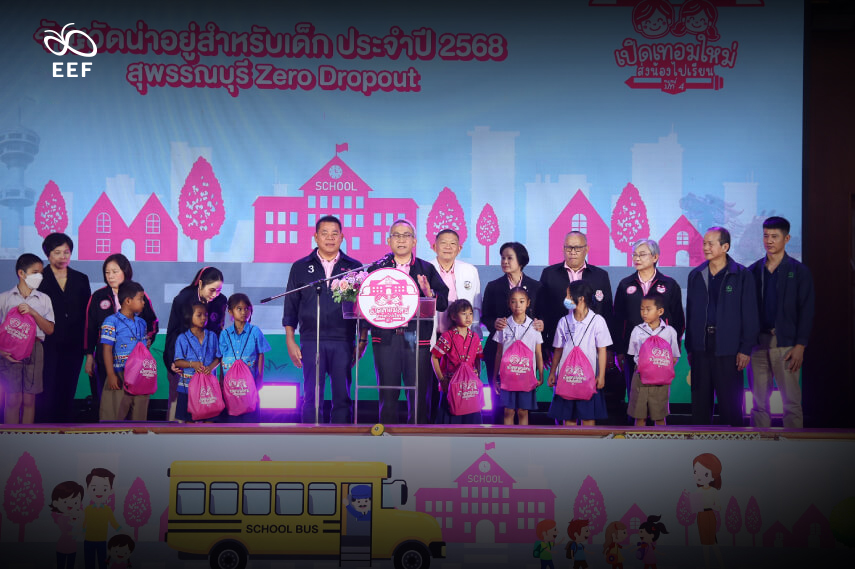
Yet, that choice cannot last without safety. For MSDHS Permanent Secretary Anukul Peedkaew, protection is non-negotiable. It is not children who must adapt to systems, but rather systems that must adapt to children. Safety and dignity are rights, not privileges. Across the media, the cost of neglect is painfully clear: in 2024 alone, over 900,000 children were found missing from the educational system, and of these, 28% were below compulsory schooling age (Grade 1-9), 40% within it, and 32% had aged out. Behind these numbers lie real children left vulnerable to systemic failure—be it abuse, abandonment, or improper care. To counter this, MSDHS in collaboration with 10 key agencies has been driving social welfare reform at the provincial level to protect the most underprivileged and marginalized. “Education, protection, and the chance to grow—every child deserves them all,” stressed the Permanent Secretary, “and we are not offering charity; we are restoring rights.” Protection has now extended to every space a child inhabits, reshaping them into safe, inclusive environments for a child-friendly future.
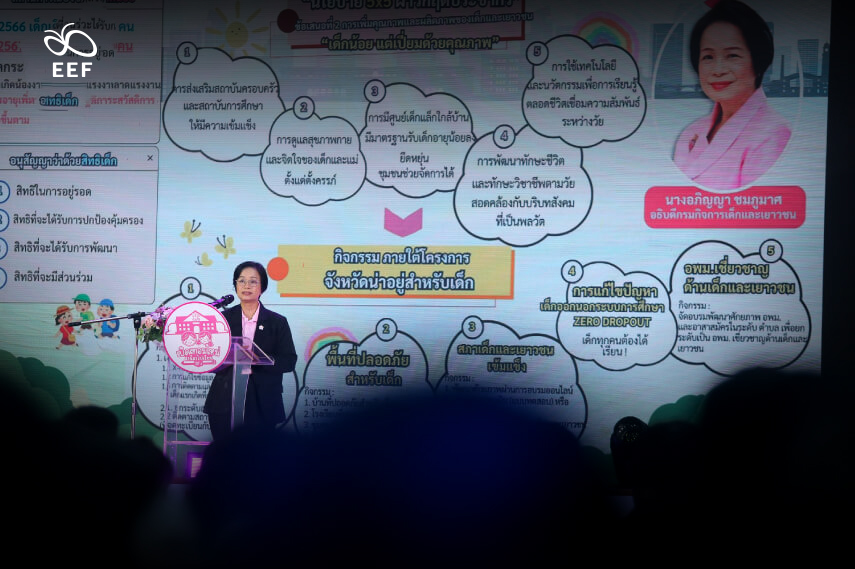
Still, protection alone does not ensure a child stays in school; retention matters just as much. DCY Director-General Apinya Chompumas understands this deeply. “To reclaim a chance is not merely to offer it,” she noted, “it is to sustain it.” Retaining every child in school starts with a guiding premise: their feeling seen, heard, and held by systems that respond when life becomes unstable. To that end, DCY has introduced five core strategies: strengthening family-school bonds, nurturing mental and physical well-being, establishing early childhood centers near homes and workplaces, fostering relevant life and vocational skills, and embracing technology to enable lifelong learning and cross-generational connection. All echo one overarching vision: meet children where they are—even if that means rethinking what education looks like or where it happens.
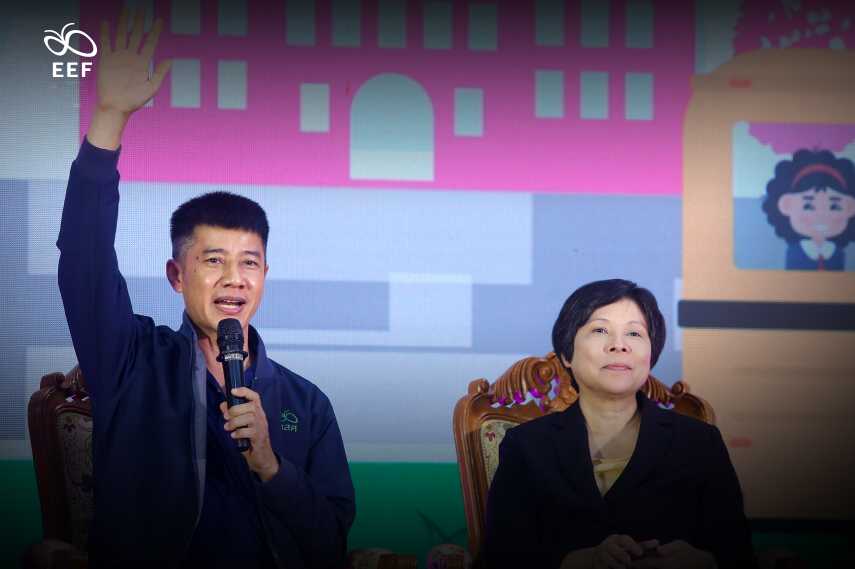
Progress, though gradual, is real; and what paves the path forward is innovation. For EEF Assistant Manager Patanapong Sukmadan, reclaiming the chance must also mean reimagining the system itself. “School is one path,” he reminded, “not the only one.” In 2025, the number of out-of-school children has declined from 1.02 million to approximately 880,000—a true testament to the Thailand Zero Dropout policy’s early promise, but also a call to press further. Education must go beyond academic benchmarks; it must connect to lived experience, local context, and individual aspiration. Suphanburi is leading this shift through the EEF’s flexible learning models: 1-School-3-Models, social institution-run learning centers, and Mobile School. Each adapts to a child’s reality, not the other way around. These flexible pathways are reshaping not only access but aspiration. Their next steps will not all look the same: some will re-enter formal classrooms, others will learn through mobile or hybrid formats. All will be given a route to complete their education and reclaim their future.
A subtle but powerful thread ties it all together: reclaiming the chance for every child. From the provincial declaration to the last village classroom, the message resounds: return, stay, grow, thrive. “If the traditional classroom fails you, don’t give up. Find another door. Speak to someone. Keep moving forward,” concluded the governor, offering hope to every child while pledging that the Thailand Zero Dropout committee and its subcommittees stand ready to support and walk alongside them at every step of their learning journey.

Across Suphanburi, coordinated efforts unite a dynamic coalition: MSDHS, DCY, and EEF. A powerful, province-wide mobilization is underway, reclaiming educational futures for thousands of children. From pledges made at the “Suphanburi Zero Dropout” declaration to community-rooted initiatives like the 1-School-3-Models and Mobile School, momentum is unmistakable. Invisible no longer, children who were once unregistered and underserved now find pathways back to learning. Yet, what truly sets this movement apart is its heart: a steadfast conviction that every child deserves more than a seat in school; they deserve a future full of possibility. With over 880,000 out-of-school children still awaiting opportunity, much remains to be done. Still, the path forward is clear and resolute.
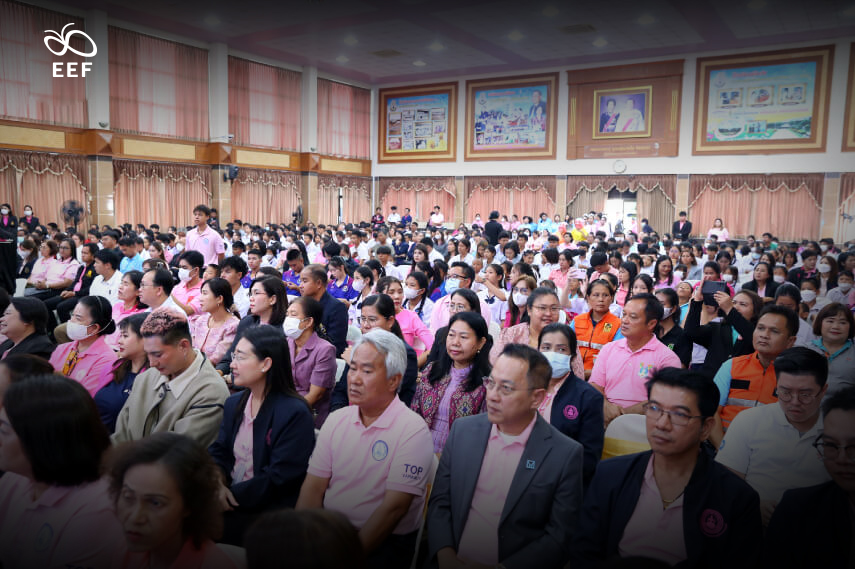
At its core, Suphanburi’s campaign transcends academic re-entry; it rewrites the narrative of equity in Thai education and society. For the EEF, this mission strikes at the very foundation of its vision: equitable, adaptive education stands as the most potent lever to break cycles of poverty and restore human dignity. Working closely with MSDHS and DCY, and rooting reform in local action, the EEF reaffirms an unshakeable truth: the right to learn cannot be separated from the right to live well.
All For Education is all about people; only when all is in for education is Education For All. Join the movement to reduce educational inequality. Support the EEF by donating to fund research, partnerships, and assistance for children, youth, and adults in need of educational support. Click the link to contribute today and help create a society where education is open and equal for all. Together, we can make a lasting impact.


